
Anacridium aegyptium
(Linnaeus, 1764)
Egyptian grasshopper, Egyptian locust, Egyptian Bird Grasshopper
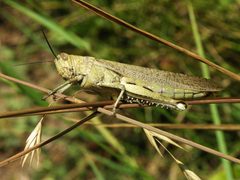
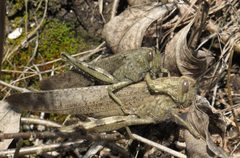
One of the largest European grasshoppers, reaching up to 70 mm in females. Distinguished by striped , blue hind tibiae, and orange hind with dark markings. Solitary and folivorous, inhabiting warm, bright environments from sea level to 1,500 m. Active year-round with most visible August–September; overwinters as adults and spawns in spring.
Pronunciation
How to pronounce Anacridium aegyptium: /ˌænəˈkrɪdiəm ˌaɪˈdʒɪptiəm/
These audio files are automatically generated. While they are not always 100% accurate, they are a good starting point.
Identification
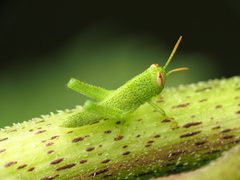
Easily identified by the combination of: vertical black and white stripes on ; blue hind tibiae contrasting with orange hind bearing dark marks; large body size; orange stripe on pronotum with white spots. Nymphs differ from : yellow to bright green or ocher coloration, with wings absent or underdeveloped.
Images
Habitat
Trees and shrubs, scrub land, maquis, and orchards in warm, bright environments. Elevation range: sea level to 1,500 m.
Distribution
Europe, Afrotropical realm, eastern , Near East, North Africa; recently observed in Cape Town, South Africa. Records from Afghanistan, Albania, Algeria, Bulgaria, Chile Central.
Seasonality
mainly observed August–September but active throughout the year. Overwinters as adults. Nymphs appear in April.
Diet
Folivore, feeding on leaves of various plants.
Life Cycle
Hemimetabolous. Spawning occurs in spring just under soil surface. Nymphs appear in April and undergo several , with wings gradually developing. overwinter.
Behavior
Solitary . locomotion exhibits nonlinear patterns with irregular turning and sharp directional changes, suggesting deliberate rather than random movement. Trajectory analysis indicates efficient spatial exploration and obstacle negotiation. Movement dynamics appear stable and predictable rather than chaotic.
Ecological Role
Folivore in scrub and orchard .
Human Relevance
Harmless to crops; not a significant agricultural pest.
Misconceptions
Despite 'Egyptian locust,' this is solitary and does not exhibit locust-phase swarming .
Sources and further reading
- BugGuide
- Wikipedia
- GBIF taxonomy match
- iNaturalist taxon
- NCBI Taxonomy
- Catalogue of Life
- Rise of the Grasshoppers: New Analysis Redraws Evolutionary Tree for Acrididae Family
- diversity of Acrididae grasshoppers - Entomology Today
- Reproduction of the grasshopper Anacridium aegyptium L. in the laboratory
- Nonlinear locomotion patterns in the Egyptian Locust (Anacridium aegyptium) during walking: a detailed case study