
Hetaerina americana
(Fabricius, 1798)
American rubyspot
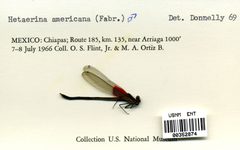
A in the Calopterygidae, commonly known as the American rubyspot. Males exhibit a lustrous red and with a brilliant green ; females have a green abdomen with either green or thoracic markings. The species occupies riverine in arid and semi-arid regions and demonstrates strong site fidelity, with rarely dispersing more than 100 meters from sites. Research indicates sensitivity to urbanization, with documented declines in abundance, body condition, and reproductive success correlated with reduced riparian vegetation and increased wastewater discharge.
Pronunciation
How to pronounce Hetaerina americana: //hɛ.taɪˈraɪ.nə əˌmɛr.ɪˈkɑː.nə//
These audio files are automatically generated. While they are not always 100% accurate, they are a good starting point.
Identification
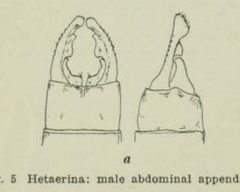
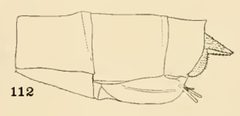
Males distinguished by lustrous red coloration on and contrasting with brilliant green . Females recognized by green abdomen with variable green or thoracic markings. Similar to Canyon Rubyspot (Hetaerina vulnerata) but reliably separated by geographic range and subtle morphological differences in caudal appendage shape; the two can be difficult to distinguish in the field where ranges overlap. Wing spot coloration is not a reliable distinguishing feature from related Hetaerina species.
Images
Habitat
Springs, streams, and rivers in dry regions; requires running water year-round and submerged vegetation for oviposition. Associated with lotic (flowing water) environments from sea level to over 2000 meters elevation. Riparian vegetation provides critical shelter from solar radiation and . Tolerates wide range of water chemistry and temperature but sensitive to alteration including reduced vegetation cover and water quality degradation.
Distribution
North America from Canada south through the United States to Central America (Chiapas, Mexico and as far south as Nicaragua). Occurs throughout California in nearly every ecoregion. in different watersheds exhibit deep genetic splits and high differentiation, suggesting limited between drainages.
Diet
Larvae are sit-and-wait of smaller in aquatic environments. capture smaller flying insects by sallying out from perches.
Life Cycle
Two-phase with aquatic larval stage and terrestrial winged stage. Larvae enter during winter months in temperate regions and development can extend up to two years before . Newly emerged adults (tenerals) are highly vulnerable to and adverse weather conditions. Adults that survive the period typically live several weeks.
Behavior
Males establish and defend territories along streams, with territorial involving aerial pursuits and physical interactions. Males are the heterogametic sex. desiccate rapidly without access to water and generally remain within 100 meters of sites despite capability for greater distances. High rates of interspecific aggression occur with sympatric , particularly Hetaerina titia and H. calverti. Mate recognition relies primarily on mechanical/sensorial cues from caudal appendage shape rather than visual wing pattern recognition.
Ecological Role
Serves as an for riverine health and predictor of trends in other with similar requirements and limited . Functions as in both aquatic (larval) and terrestrial () . Larvae provide food source for amphibians and fish; adults are prey for terrestrial arthropods and vertebrates. Population declines may contribute to increased mosquito abundance and disruption of aquatic and terrestrial food webs.
Human Relevance
Subject of ecological research on urbanization impacts and watershed conservation. sequenced as part of the California Conservation Project, providing resources for landscape genomic studies and conservation prioritization. Not currently listed as endangered, though ongoing urbanization along river systems poses concern for persistence.
Similar Taxa
- Hetaerina vulnerataCanyon Rubyspot; similar size and coloration, overlapping in some geographic areas; distinguished by subtle differences in caudal appendage and range in much of its distribution
- Hetaerina titiaSmoky Rubyspot; occurs in sympatry; interspecific territoriality documented, with H. titia males typically displacing H. americana males; distinguished by different wing coloration patterns and thoracic markings
- Hetaerina calvertiOccurs in sympatry in parts of Mexico and Central America; cryptic with similar wing spot coloration but complete reproductive isolation maintained by divergence in superior caudal appendage shape
Sources and further reading
- BugGuide
- GBIF taxonomy match
- iNaturalist taxon
- NCBI Taxonomy
- Catalogue of Life
- Dragonfly Enthusiasts, Unite! Open House Set Nov. 6 at Bohart Museum | Bug Squad
- As a Watershed is Urbanized, Damselflies Show Declines
- Bug Eric: Filigree Skimmers Are Back
- Bug Eric: New Mexico Dragonfly Blitz - Day 3
- Silphidae | Beetles In The Bush
- Bug Eric: New Mexico Dragonfly Blitz - Day 2
- Reproductive behaviour of the damselfly, Hetaerina americana (Fabricius) (Odonata: Calopterygidae)
- Morphological variation and reproductive isolation in the Hetaerina americana species complex
- Reference genome for the American rubyspot damselfly, Hetaerina americana
- Breeding Behaviour and Oviposition in Hetaerina americana (Fabricius) and H. titia (Drury) (Odonata: Agriidae)
- A Description of Territorial Behavior and a Quantitative Study of its Function in Males ofHetaerina americana(Fabricius) (Odonata: Agriidae)
- Interspecific Territoriality in Hetaerina americana (Fabricius) and H. titia (Drury) (Odonata: Calopterygidae) with a Preliminary Analysis of the Wing Color Pattern Variation