
Hetaerina vulnerata
Hagen in Selys, 1853
Canyon Rubyspot
Hetaerina vulnerata, the Canyon Rubyspot, is a in the Calopterygidae. It inhabits shaded mountain streams at elevations of 550-2000 meters from Colombia through the southwestern United States. The shows limited capacity and strong specificity, with genetically isolated by unsuitable terrain. Climate change projections suggest increasing habitat fragmentation for this stream- insect.
Pronunciation
How to pronounce Hetaerina vulnerata: //hɛˈtaɪərɪnə ˌvʌlnəˈreɪtə//
These audio files are automatically generated. While they are not always 100% accurate, they are a good starting point.
Identification
Distinguished from the congeneric American Rubyspot (Hetaerina americana) by preference—Canyon Rubyspot occupies shaded mountain streams while American Rubyspot occurs in more open riverine environments. H. vulnerata is associated with higher elevations and more mesic conditions. The two may co-occur in some areas of the southwestern United States, requiring careful observation of microhabitat use for reliable field identification.
Images
Appearance
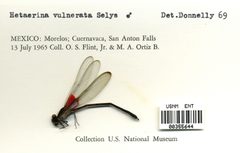
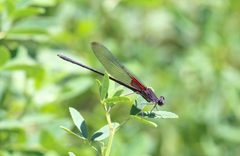
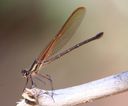
Medium-sized with broad, colored wings typical of the Calopterygidae. Males display ruby-red wing bases or spots, a characteristic feature of the Hetaerina. Wings are relatively broad compared to families. Body is slender with elongated typical of Zygoptera.
Habitat
Shaded mountain streams in high-altitude areas from 550-2000 meters above sea level. Requires riparian vegetation with tree coverage for , nighttime refugia, and postcopulatory resting. Occupies narrow spring-fed streams and river channels with overhanging vegetation. Strongly associated with forested watersheds; tree canopy is a critical predictor.
Distribution
Range extends from Colombia through Central America and North America to the arid southwestern United States (Arizona, New Mexico, Utah). Seven current potential clusters identified in the US portion of range, isolated by unsuitable . Present in Middle America, North America, and South America.
Life Cycle
Aquatic and (naiad/nymph) stages in streams; aerial/terrestrial stage. Oviposition occurs in shaded riparian areas with tree coverage.
Behavior
Relatively slow-flying with limited capacity. exhibit territoriality and postcopulatory resting in shaded riparian areas. Activity patterns tied to shaded conditions for .
Ecological Role
Considered an important wetland due to strong specificity and sensitivity to riparian vegetation condition. Aquatic nymphs function as in stream ; serve as prey for birds and other .
Human Relevance
Subject of conservation concern due to vulnerability. Research focus for understanding effects of climate change and habitat fragmentation on stream insects. Used as a model for landscape genetics and species distribution modeling studies.
Similar Taxa
- Hetaerina americanaOverlapping range in southwestern US; distinguished by preference for open riverine versus shaded mountain streams, and generally lower elevation occurrence
More Details
Genetic Isolation
separated by expanses of unsuitable show FST values >0.15, indicating substantial genetic differentiation. Isolation by environment and intervening landscape explain significant , while isolation by distance is weak.
Climate Vulnerability
Paleoclimate models indicate past contiguity; future projections suggest increased habitat fragmentation. Tree loss poses particular threat due to its importance for oviposition, territoriality, and .
Sources and further reading
- BugGuide
- Wikipedia
- GBIF taxonomy match
- iNaturalist taxon
- NCBI Taxonomy
- Catalogue of Life
- Dragonfly Enthusiasts, Unite! Open House Set Nov. 6 at Bohart Museum | Bug Squad
- Bug Eric: New Mexico Dragonfly Blitz - Day 2
- Bug Eric: New Mexico Dragonfly Blitz - Day 3
- As a Watershed is Urbanized, Damselflies Show Declines
- Meloidae | Beetles In The Bush | Page 3
- Idaho | Beetles In The Bush
- Species distribution models predict genetic isolation of Hetaerina vulnerata Hagen in Selys, 1853 (Odonata, Calopterygidae)