
Calopterygidae
Selys, 1850
broad-winged damselflies, demoiselles, jewelwings
Genus Guides
2- Calopteryx(Jewelwings)
- Hetaerina(Rubyspots)
is a of damselflies in the suborder Zygoptera, containing approximately 150 . Members are relatively large for damselflies, with wingspans of 50–80 mm, and are characterized by broad wings with wide bases, metallic coloration, and a distinctive pattern described as jerky and fluttering. The family is distributed across all continents except Antarctica, primarily associated with running water .
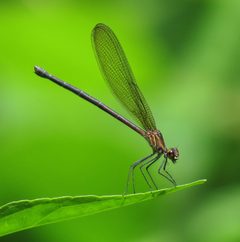
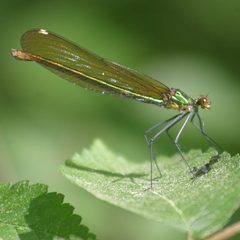
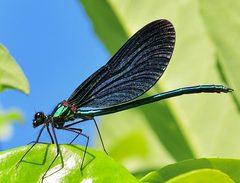
Pronunciation
How to pronounce Calopterygidae: //ˌkæloʊˈtɛrɪdʒɪˌdiː//
These audio files are automatically generated. While they are not always 100% accurate, they are a good starting point.
Identification
Distinguished from other by the broader, more gradual connection between wings and body, as opposed to the abrupt narrowing seen in families like Coenagrionidae. The combination of metallic coloration, broad wings held parallel to the body at rest, and the absence of pterostigmata in males separates from most other Zygoptera. The jerky, fluttering pattern, described as -like, contrasts with the stable hovering of many other damselflies.
Images
Appearance
have metallic bodies, often with blue, green, or coloration. Wings are broader at the base than other damselflies, with 18 or more antenodal . Males typically have blue wings without pterostigmata; females have green or brown wings. Some display conspicuous wing coloration. is common, with color intensity fading with age. At rest, wings are held parallel to the body, slightly elevated. The first antennal segment is longer than the remaining segments combined. Nymphs have a flattened, pentagonal-shaped , long first antennal segment, long legs, and lateral gills longer than gills.
Habitat
and nymphs are strongly associated with lotic environments—rivers, streams, and creeks. Nymphs inhabit submerged aquatic plants, woody debris, and exposed roots of streamside vegetation. Adults typically remain within 100 meters of water, perching horizontally on twigs near water edges. Riparian vegetation, including trees and shrubs at least 1 meter in height, provides essential perching sites and shade.
Distribution
Found on every continent except Antarctica. Present in North America, Central America, South America, Europe, Asia, Africa, and Australia. Specific study documented in the Amacuzac River, Morelos State, Mexico; southern Italy; and Sulawesi, Indonesia.
Diet
and larvae are . Larvae feed on smaller , including mayflies. Adults spend substantial time feeding to build physiological reserves (muscle mass and lipids) necessary for .
Life Cycle
Hemimetabolous development with aquatic larval and terrestrial stages. Nymphal development typically spans 3–5 months, though duration varies with temperature and food availability. One per year in temperate regions; year-round documented in some tropical . Last-instar larvae sampled September–November in some populations. masses laid on aquatic substrates such as submerged floating root mats or plants at 5–15 cm depth.
Behavior
Males are often territorial, defending riverine used by females for oviposition. Some exhibit alternative mating tactics with territorial and non-territorial male morphs that may differ in coloration. Courtship includes wing displays by males; at least one (Hetaerina) displays lekking . During mating, males use spines on the intromittent organ to remove rival sperm and stimulate female muscle contraction to expel sperm. Males frequently accompany females during oviposition site selection and may remain attached; post-copulatory guarding occurs to prevent rival mating. is irregular and unsteady in males due to threatening displays, while female flight is more regular. Both sexes exhibit wing standstills during forward flight. rarely fly beyond 100 meters from water. Peak activity 11:00–14:00 hours.
Ecological Role
Function as of smaller in both aquatic and terrestrial . Serve as bioindicators due to dependence on both aquatic and terrestrial . Nymphs provide food for fish and amphibians; are prey for birds, , and other terrestrial predators. Contribution to mosquito control through . Structuring components of aquatic and riparian .
Human Relevance
Used as for assessing riverine health and urbanization impacts. decline with degradation, including reduced riparian vegetation and water quality impairment from wastewater. Research on has contributed to understanding of , female-limited , and territoriality. Some , such as the ebony jewelwing (Calopteryx maculata), are familiar to naturalists and photographers due to their conspicuous appearance.
Similar Taxa
- CoenagrionidaeCoenagrionidae damselflies have abruptly narrowed wing bases and typically lack the metallic coloration and broad wings of ; they also exhibit stable hovering rather than the fluttering flight of Calopterygidae
- LestidaeSpreadwing damselflies hold wings at an angle away from the body at rest, unlike which hold wings parallel to the body; Lestidae also lack the broad wing bases and metallic coloration typical of Calopterygidae
More Details
Female-limited polymorphism
Some of Calopteryx splendens exhibit female-limited color with gynochrome (transparent-winged) and androchrome (dark spotted-winged) morphs. Recent evidence suggests this polymorphism is maintained by intraspecific mechanisms such as male mimicry or frequency-dependent selection rather than interspecific harassment as previously hypothesized.
Morphological plasticity
Wing length in at least one shows plasticity correlated with forest proximity to water; greater forest cover correlates with longer wings, likely reflecting altered requirements in more enclosed .
Subfamilies
The is divided into two : Calopteryginae (demoiselles, including Calopteryx, Matrona, Neurobasis) and Hetaerininae (rubyspots, including Hetaerina, Mnesarete).
Sources and further reading
- BugGuide
- Wikipedia
- GBIF taxonomy match
- iNaturalist taxon
- NCBI Taxonomy
- Catalogue of Life
- Calopterygidae | Beetles In The Bush
- As a Watershed is Urbanized, Damselflies Show Declines
- Reproductive behaviour of Neurobasis kaupi (Odonata: Calopterygidae)
- Damselfly (Odonata: Calopterygidae) Population Decline in an Urbanizing Watershed
- Double function of flight in Calopteryx splendens (Odonata: Calopterygidae) males
- Distributional Patterns and Their Interpretation in Hetaerina (Odonata: Calopterygidae)
- Breeding Behavior and Oviposition in Calopteryx Maculatum (Beauvais) (Odonata: Calopterygidae)
- Intraspecific rather than interspecific drivers of female-limited polymorphism in Calopteryx splendens (Odonata: Calopterygidae)
- Variability, Distribution and Taxonomy of Calopteryx dimidiata (Zygoptera: Calopterygidae)
- Evolution and ecology of Calopterygidae (Zygoptera: Odonata): status of knowledge and research perspectives