
Hetaerina
Hagen in Selys, 1853
Rubyspots
Species Guides
3- Hetaerina americana(American rubyspot)
- Hetaerina titia(smoky rubyspot)
- Hetaerina vulnerata(Canyon Rubyspot)
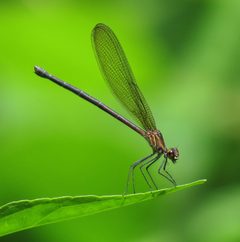
Hetaerina is a of in the Calopterygidae, commonly known as rubyspots due to the deep red wing bases of males. The genus comprises approximately 40 distributed throughout the Americas, with highest diversity in tropical South America. Males exhibit pronounced with iridescent metallic bodies and characteristic red wing spots, while females have pale brown wings and cryptically patterned bodies. The genus is notable for its mating system, which is uncommon among Odonata, and has become an important study system for research.
Pronunciation
How to pronounce Hetaerina: /hɛ.taɪˈriː.nə/
These audio files are automatically generated. While they are not always 100% accurate, they are a good starting point.
Identification
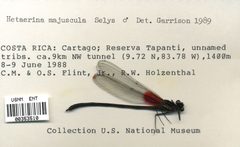
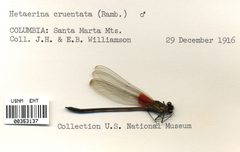
Males distinguished by deep red wing bases and iridescent metallic bodies. Females difficult to identify to due to cryptic coloration and similarity across species. Caudal appendage shape serves as key diagnostic character for species separation, particularly in the H. americana . Wing spot coloration alone is not diagnostic between closely related species. Species-level identification often requires examination of male genital .
Images
Habitat
Primarily lotic : streams and rivers. Highest in tropical regions of South America. Requires both aquatic habitat for larval development and adjacent terrestrial vegetation for activities. Vegetation along water bodies provides shelter from sun and protection from .
Distribution
Throughout the Americas from Canada to Argentina. Most restricted to tropical and subtropical regions of South and Central America. Only H. americana, H. titia, and H. vulnerata range north of Mexico. H. titia has the largest latitudinal range of any Hetaerina species, extending from Canada to Panama.
Diet
Visual . capture prey on the wing. Larvae are aquatic predators.
Life Cycle
Two-stage development: aquatic larval stage followed by terrestrial stage. Larval stage occupied primarily by feeding until sexual maturity. Adult stage devoted to . Oviposition in submerged vegetation.
Behavior
Exhibits (except H. rosea with resource-defense polygyny), uncommon among Odonata. Males compete intensely for mating territories at water sites. No pre-copulatory . Males exhibit aggressive harassment of females before and during copulation. Alternative mating strategies include territorial defense and non-territorial pursuit of tandem pairs. Some males switch between territorial and non-territorial tactics. Copulation involves three stages: male grasping and sperm transfer, tandem flying with aggressive chasing by other males, and oviposition with male guarding.
Ecological Role
Important ecological indicator organisms due to dependence on both aquatic and terrestrial . Sensitive to environmental disruptions including habitat degradation, water quality changes, and vegetation loss. of pest insects including mosquitoes. Larvae provide food for fish and amphibians; provide food for terrestrial arthropods and vertebrates.
Human Relevance
Subject of extensive research in and evolutionary . H. rudis (Guatemalan rubyspot) listed as vulnerable on IUCN Red List. , particularly H. americana, show declines correlated with urbanization and degradation. Used as bioindicator for stream and river health.
Similar Taxa
- MnesaretePhylogenetic analyses suggest Mnesarete may be nested within Hetaerina; historically caused confusion between .
- OrmenophlebiaRecent phylogenetic studies indicate this may be nested within Hetaerina, contributing to historical taxonomic uncertainty.
- CalopteryxRelated in same ; Hetaerina distinguished by red wing bases in males versus other color patterns in Calopteryx.
More Details
Etymology
name from Ancient Greek ἑταίρα (hetaira), meaning courtesan.
Phylogenetic Uncertainty
Recent analyses suggest Mnesarete and Ormenophlebia may be nested within Hetaerina, indicating potential need for taxonomic revision.
Speciation Mechanisms
Hetaerina likely represent a non-adaptively radiating clade with minimal ecological differentiation between species. Reproductive isolation evolves through divergence in genital rather than ecological .
Character Displacement
Wing pigmentation shows agonistic character displacement between sympatric , driven by male-male competition rather than species recognition. Body size also shows character displacement in sympatry.
Sources and further reading
- BugGuide
- Wikipedia
- GBIF taxonomy match
- iNaturalist taxon
- NCBI Taxonomy
- Catalogue of Life
- Dragonfly Enthusiasts, Unite! Open House Set Nov. 6 at Bohart Museum | Bug Squad
- Bohart Museum Open House: Dragonflies Rule! | Bug Squad
- Hetaerina americana damselfly - Entomology Today
- Hetaerina americana damselfly - Entomology Today
- As a Watershed is Urbanized, Damselflies Show Declines
- Bug Eric: New Mexico Dragonfly Blitz - Day 3
- Distributional Patterns and Their Interpretation in Hetaerina (Odonata: Calopterygidae)
- Morphological variation and reproductive isolation in the Hetaerina americana species complex
- Spatiotemporal Dynamics of Non-Ecological Speciation in Rubyspot Damselflies (Hetaerina spp.).