
Calopteryx
Leach, 1815
Jewelwings
Species Guides
5- Calopteryx aequabilis(River Jewelwing)
- Calopteryx amata(Superb Jewelwing)
- Calopteryx angustipennis(Appalachian jewelwing)
- Calopteryx dimidiata(Sparkling Jewelwing)
- Calopteryx maculata(Ebony Jewelwing)
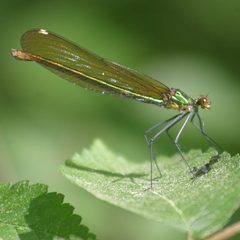
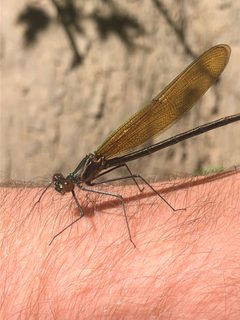
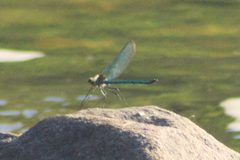
Calopteryx is a of large damselflies in the Calopterygidae, commonly known as jewelwings. Males typically display brightly colored wings while females usually have clear wings, though some females develop male-like (androchrome) wing characteristics. The genus lacks a pterostigma, a wing found in most other odonates. occupy distinct zones within running water systems, with differential thermal adaptations driving segregation.
Pronunciation
How to pronounce Calopteryx: /kæˈlɒptrɪks/
These audio files are automatically generated. While they are not always 100% accurate, they are a good starting point.
Identification
Distinguished from other by the absence of a pterostigma on the wings. Males often have metallic or colored wings (blue, green, or black depending on ), while females are generally more subdued with clear or lightly tinted wings. Large body size relative to other damselflies. Wing venation and body proportions differ from similar genera in Calopterygidae such as Hetaerina (rubyspots).
Images
Habitat
Running water systems including streams and rivers. Specific occupy distinct longitudinal zones: C. virgo inhabits rhitron (upper stream) zones, while C. splendens prefers hyporhitron to metapotamon (middle to lower stream) zones. Riparian vegetation and clean, flowing water are typical requirements.
Distribution
Holarctic distribution with in North America, Europe, and Asia. C. maculata (ebony jewelwing) and C. aequabilis (river jewelwing) occur in North America. C. virgo and C. splendens are widespread in Europe. Specific range limits vary by species.
Life Cycle
Aquatic larval stage in running water. Larval growth rates vary by and temperature: C. virgo shows faster growth and higher metabolism at lower temperatures compared to C. splendens. emerge from stream .
Behavior
Males exhibit territorial along streams, with territory defense and mate acquisition strategies influenced by prior mating success. Males obtaining early copulations often secure additional copulations later the same day. Response to (frogs, water spiders) varies with territorial investment: recently established males flee immediately after attack, while long-term occupants with courtship history remain but avoid the predator's immediate location. performance correlates with wing ; western of C. maculata have lower wing aspect ratio (shorter, broader wings) than eastern populations, potentially reflecting selection for efficient long-distance flight in more variable precipitation regimes.
Similar Taxa
- HetaerinaAlso in Calopterygidae, but distinguished by presence of red or amber wing bases (rubyspots) in males and different wing venation patterns.
- Other Zygoptera families (Coenagrionidae, Lestidae)Smaller body size, presence of pterostigma, and different wing posture at rest (wings folded together above body in Coenagrionidae, partially spread in Lestidae) distinguish these from Calopteryx.
More Details
Thermal Adaptation and Species Segregation
Larval respiration studies demonstrate that C. virgo is cold-adapted with elevated metabolic rates at lower temperatures, while C. splendens maintains stable respiration across 12-24°C. This physiological differentiation contributes to segregation despite C. virgo's superior growth rate even at warmer temperatures, suggesting additional factors beyond thermal performance prevent co-occurrence in warm streams.
Wing Morphology Variation
Geographic variation in wing aspect ratio has been documented in C. maculata, with western North American showing lower aspect ratio (shorter, broader wings) than eastern populations. This longitudinal pattern may relate to increasing precipitation variability from east to west, with wing shape potentially reflecting selection for different performance requirements.
Sources and further reading
- BugGuide
- Wikipedia
- iNaturalist taxon
- NCBI Taxonomy
- Catalogue of Life
- Dragonfly Enthusiasts, Unite! Open House Set Nov. 6 at Bohart Museum | Bug Squad
- Bohart Museum Open House: Dragonflies Rule! | Bug Squad
- Calopterygidae | Beetles In The Bush
- Explaining species distribution in running water systems: larval respiration and growth of two Calopteryx species (Odonata, Zygoptera)
- TO STAY OR NOT TO STAY: DECISION-MAKING DURING TERRITORIAL BEHAVIOUR OFCALOPTERYX HAEMORRHOIDALISANDCALOPTERYX SPLENDENS SPLENDENS(ZYGOPTERA: CALOPTERYGIDAE)
- Strong longitudinal variation in wing aspect ratio of a damselfly, Calopteryx maculata (Odonata: Zygoptera)