
Hetaerina titia
(Drury, 1773)
smoky rubyspot
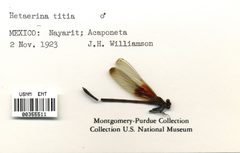
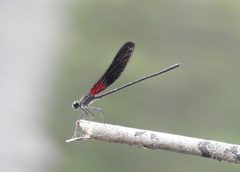
Hetaerina titia, the smoky rubyspot, is a in the Calopterygidae. It is one of the most commonly encountered odonates along streams and rivers from Panama to southern Canada, representing the largest latitudinal range of any in the Hetaerina. The species exhibits highly variable wing melanin pigmentation, both seasonally and geographically, and has become a model system for studying and interspecific behavioral interference. Its IUCN conservation status is Least Concern with a stable .
Pronunciation
How to pronounce Hetaerina titia: //hɛˈtaɪrə.nə ˈtɪʃiə//
These audio files are automatically generated. While they are not always 100% accurate, they are a good starting point.
Identification
Hetaerina titia can be distinguished from by its smoky wing pigmentation, which is highly variable in melanin patterning. The "tricolor" form, characterized by distinct wing coloration patterns, has been suggested as potentially representing a separate based on behavioral and morphological differences. Males of typical H. titia and the "tricolor" form differ in territorial and responses to sympatric H. americana. Females of H. titia and the "tricolor" form exhibit different and consistent body color patterns. Where sympatric with H. americana, H. titia typically initiates interspecific territorial encounters and usually displaces H. americana males.
Images
Habitat
Streams and rivers; riparian areas along banks where males establish and defend mating territories. are most frequently observed around trees and shrubs overhanging moving water. In central Texas, breeds sympatrically with H. americana on streams.
Distribution
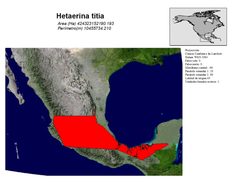
Both slopes of Central America and Atlantic drainages in the United States and southern Canada. Range extends from Panama in the south to Canada in the north, representing the largest latitudinal range of any Hetaerina . Northern range limit includes well-established in the lower Thames and Sydenham Rivers in southwestern Ontario, first documented in 1985.
Seasonality
appear from mid-August to early September in the northern part of the range (southwestern Ontario). Seasonal variation in wing pigmentation has been documented.
Behavior
Males defend mating territories along stream and river banks. Territorial males perch higher and in slower parts of streams than sympatric . Females descend from higher hunting perches to rivers primarily to mate and oviposit. Interspecific territoriality with H. americana is initiated by either and usually results in displacement of the H. americana male, though this does not visibly affect H. americana structure. The "tricolor" form exhibits markedly different territorial : interspecific territoriality with H. americana is initiated only by H. americana males, and this affects the spatial structure of "tricolor" breeding populations. Species recognition for mating involves optical stimuli including wing coloration patterns; clear-winged relatives rely on abdominal appendage shape and body coloration.
Human Relevance
Used as a model organism for ecological and evolutionary research, particularly regarding , interspecific behavioral interference, and wing pigmentation variation. Subject of -level assembly to enable further studies of ecological and evolutionary forces shaping biological diversity. Serves as an indicator of riverine health; declines have been documented in response to urbanization and degradation in related Hetaerina .
Similar Taxa
- Hetaerina americanaSympatric on streams in central Texas and elsewhere; distinguished by wing coloration patterns, abdominal appendage , and behavioral differences in territorial initiation and outcomes. H. titia typically initiates and wins interspecific territorial encounters.
- Hetaerina vulnerata in the same ; Canyon Rubyspot found in southwestern North American streams.
- Hetaerina 'tricolor' formPhenotypically distinct form of H. titia or potentially separate ; differs in breeding and territorial , female body color patterns, and male wing color patterns that appear genetically governed.
Sources and further reading
- BugGuide
- Wikipedia
- GBIF taxonomy match
- iNaturalist taxon
- NCBI Taxonomy
- Catalogue of Life
- Dragonfly Enthusiasts, Unite! Open House Set Nov. 6 at Bohart Museum | Bug Squad
- Bohart Museum Open House: Dragonflies Rule! | Bug Squad
- Hetaerina americana damselfly - Entomology Today
- As a Watershed is Urbanized, Damselflies Show Declines
- Bug Eric: Filigree Skimmers Are Back
- Bug Eric: New Mexico Dragonfly Blitz - Day 2
- A chromosome-level genome assembly for the smoky rubyspot damselfly (Hetaerina titia)
- Distribution of <i>Hetaerina Titia</i> (Odonata: Calopterygidae) in the Eastern Great Lakes Region
- Breeding Behaviour and Oviposition in Hetaerina americana (Fabricius) and H. titia (Drury) (Odonata: Agriidae)
- Interspecific Territoriality in Hetaerina americana (Fabricius) and H. titia (Drury) (Odonata: Calopterygidae) with a Preliminary Analysis of the Wing Color Pattern Variation