
Sympetrum corruptum
(Hagen, 1861)
Variegated Meadowhawk
Sympetrum corruptum, commonly known as the Variegated Meadowhawk, is a migratory native to North America. It is one of five tracked by the Migratory Dragonfly Partnership due to its seasonal north-south movements. are notable for their distinctive red-marked coloration and persistence late into autumn, often being the last active dragonflies in many areas. The species is abundant in diverse including wetlands, grasslands, and even agricultural areas like lavender fields.
Pronunciation
How to pronounce Sympetrum corruptum: /sɪmˈpɛtrəm kəˈrʌptəm/
These audio files are automatically generated. While they are not always 100% accurate, they are a good starting point.
Identification
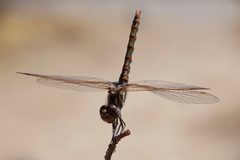
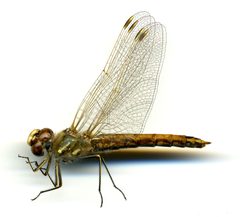
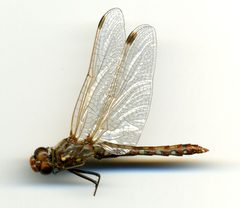
Distinguished from other Sympetrum by its variegated pattern combining reddish-brown, yellow, and black markings. Males develop bright red markings on the and . The shows distinct yellow lateral stripes against a brown background. Wings are clear with a small amber or brownish patch at the base. Similar to other meadowhawks but with more complex, mottled coloration rather than uniform red. Females and males are more yellowish-brown with less vivid markings.
Images
Habitat
Occupies a wide range of open including wetlands, marshes, ponds, lakeshores, grasslands, glades, and agricultural fields. Frequently found in xeric grasslands and rocky outcrops during fall . Tolerates both aquatic breeding sites and terrestrial foraging areas well away from water.
Distribution
Native to North America with records from Canada through the United States to Mexico. Documented in the western United States including California, Colorado, and New Mexico; also present in the Midwest (Missouri) and presumably across much of the continent. GBIF records indicate presence in Middle America and Europe/Northern Asia, though these may represent vagrant or introduced .
Seasonality
Active from spring through late autumn, with peak abundance in fall. One of the latest-flying in many regions, persisting into October and sometimes November. Migratory move north in spring and south in fall, with southbound movements observed in autumn.
Diet
Behavior
Migratory, traveling north in spring and returning to southern in fall. perch conspicuously on vegetation, rocks, and bare ground, often returning to the same perch after short . Males may be territorial around breeding sites. Known for late-season activity when most other have become inactive.
Ecological Role
Human Relevance
Subject of citizen science monitoring through the Migratory Partnership. Frequently photographed due to approachable perching and late-season visibility. Occasionally mistaken for other red dragonflies. Poses no threat to humans; non-stinging and non-biting.
Similar Taxa
- Sympetrum madidumRed-veined Meadowhawk shares red abdominal markings but has more uniform coloration and distinct red in wings rather than variegated pattern
- Sympetrum internumCherry-faced Meadowhawk has solid red in males and less complex thoracic pattern
- Sympetrum obtrusumWhite-faced Meadowhawk has pale white in males and more subdued coloration overall
- Sympetrum costiferumSaffron-winged Meadowhawk has yellow-orange wing bases and more uniform body coloration
Sources and further reading
- BugGuide
- GBIF taxonomy match
- iNaturalist taxon
- NCBI Taxonomy
- Catalogue of Life
- Lovin' the Lavender | Bug Squad
- Know Your Dragonflies! | Bug Squad
- 🪲 Entomologizing w/ the WGNSS Entomology Group at Hughes Mountain Natural Area — 11 Oct 2025 | Beetles In The Bush
- Citizen Scientists Needed for the Migratory Dragonfly Partnership
- Bug Eric: Bosque del Apache National Wildlife Refuge
- Bug Eric: Shoot First, Ask Questions Later