
Sympetrum obtrusum
(Hagen, 1867)
White-faced Meadowhawk
Sympetrum obtrusum, the White-faced Meadowhawk, is a in the Libellulidae. males are distinguished by a pure white and red bodies. The is found in the northern United States and southern Ontario. Research has documented physiological variation in postcopulatory mate-guarding in this species.
Pronunciation
How to pronounce Sympetrum obtrusum: /sɪmˈpɛtrəm ɒbˈtruːsəm/
These audio files are automatically generated. While they are not always 100% accurate, they are a good starting point.
Identification
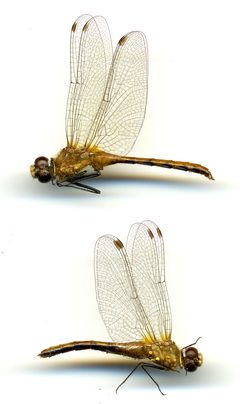
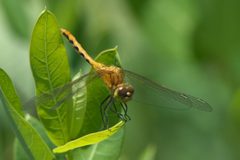
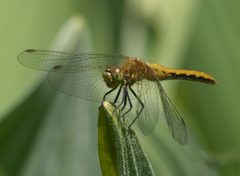
males are readily identified by the combination of a pure white and red body coloration. This separates them from other Sympetrum in their range, such as the Variegated Meadowhawk (S. corruptum) which has patterned, variegated coloration rather than uniform red with a white face.
Images
Appearance
males have a distinctive pure white and red bodies. As a member of the Sympetrum, it shares the typical meadowhawk body plan with relatively broad, somewhat flattened and clear wings held horizontally at rest.
Habitat
Specific details are not documented in available sources. As a northern meadowhawk , it likely occupies wetlands and associated open areas typical for the .
Distribution
Northern United States and southern Ontario, Canada.
Behavior
Males exhibit postcopulatory mate-guarding , with variation in this behavior being physiologically mediated. The function of this guarding is to prevent sperm competition.
Similar Taxa
- Sympetrum corruptumSimilar size and general meadowhawk appearance, but S. corruptum has variegated, patterned coloration rather than the uniform red body and pure white of male S. obtrusum.
More Details
Research significance
S. obtrusum has been studied as a model for understanding the physiological basis of reproductive variation in , specifically postcopulatory mate-guarding.
Sources and further reading
- BugGuide
- GBIF taxonomy match
- iNaturalist taxon
- NCBI Taxonomy
- Catalogue of Life
- Lovin' the Lavender | Bug Squad
- The Day That Dragonflies Sprang to Life | Bug Squad
- Beauties in the Bog - Buglife Blog - Buglife
- 🪲 Entomologizing w/ the WGNSS Entomology Group at Hughes Mountain Natural Area — 11 Oct 2025 | Beetles In The Bush
- Citizen Scientists Needed for the Migratory Dragonfly Partnership
- Bug Eric: Shoot First, Ask Questions Later
- A physiological basis of variation in postcopulatory behaviour in a dragonfly Sympetrum obtrusum