
Sympetrum
Newman, 1833
meadowhawks, darters
Species Guides
13- Sympetrum ambiguum(Blue-faced Meadowhawk)
- Sympetrum corruptum(Variegated Meadowhawk)
- Sympetrum costiferum(Saffron-winged Meadowhawk)
- Sympetrum danae(Black Darter)
- Sympetrum illotum(cardinal meadowhawk)
- Sympetrum internum(Cherry-faced Meadowhawk)
- Sympetrum madidum(red-veined meadowhawk)
- Sympetrum obtrusum(White-faced Meadowhawk)
- Sympetrum pallipes(Striped Meadowhawk)
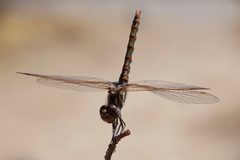
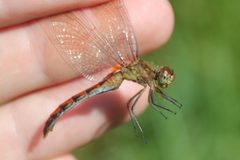
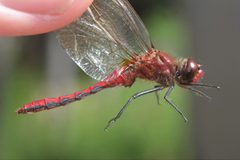
Sympetrum is a of small to medium-sized skimmer comprising over 50 . Most species inhabit the temperate zone of the Northern Hemisphere, with 11 species native to Europe and 15 to North America; a few species occur in tropical Africa and South America, but none are native to Australasia. Most species are active in late summer and autumn, breeding in ponds and foraging over meadows. Juveniles are typically yellow-gold, with mature males and some females developing bright red or orange-red coloration; the Holarctic Sympetrum danae is an exception with black males lacking red.
Pronunciation
How to pronounce Sympetrum: /sɪmˈpɛtrəm/
These audio files are automatically generated. While they are not always 100% accurate, they are a good starting point.
Identification
The can be recognized by small to medium body size within Libellulidae. Many show distinctive color changes with maturity: juveniles are yellow-gold, while mature males typically develop bright red or orange-red bodies. The variegated meadowhawk (S. corruptum) has a uniquely two-toned pterostigma and two black spots at the end of the . Male accessory genitalia and vulvar are used for species-level identification, though these characters show greater variability than previously recognized. Sympetrum danae is distinguished by all-black males without red coloration.
Images
Habitat
Aquatic with silt-detritus substrates and macrophyte vegetation; warm shallow water areas with submerged and emergent plants. occupy diverse elevations from plains (150-450 m) through foothills (450-1000 m) to mountain zones (>1000 m), though specific elevational ranges vary by species. Breeding occurs in ponds, lakes, and swamps; forage over meadows, marshes, roads, and lawns.
Distribution
Predominantly Northern Hemisphere temperate zone: 11 native to Europe, 15 to North America, most remainder in Asia. Documented in SW Romania (Timiș Plain, Oltenia region), Kabardino-Balkaria (North Caucasus), and throughout United States and southern Canada. Peripheral distributions include tropical and southern Africa (S. fonscolombii) and South America (S. evanescens, S. gilvum, S. roraimae, S. villosum). No native species in Australasia.
Seasonality
Most fly in late summer and autumn. Active and occurs June-July in studied ; peaks in April at vegetation period start, declining through September.
Diet
Larvae are predatory, feeding on small including secondary aquatic insect larvae, small oligochaete worms, , and branchiopod crustaceans. Intraspecific on younger conspecifics has been observed in S. vulgatum. are aerial capturing live insects in midair, including small taken with mouthparts and larger prey grasped with legs.
Life Cycle
Preimaginal stages develop in aquatic . are laid in open water of ponds and lakes, accompanied by males in tandem. Larval distribution is heterogeneous, determined by presence of water bodies with suitable factor complexes for preimaginal development.
Behavior
exhibit predatory hunting , perching between to consume prey. They readily perch on grass stems, tree branches, and other vegetation; some perch on ground more frequently than . Mating occurs while perched on twigs or stems, with bodies hooked together in wheel position. Mass movements and events have been documented, particularly in S. corruptum, where groups appear in response to prey availability then move on. Competitive interactions occur among sympatric species with similar ecological requirements. Adults can reach flight speeds up to 30 miles per hour, with ability to fly forward and backward, pivot rapidly, and hover.
Ecological Role
Larvae serve as bioindicators of hydrobiocenoses, responding sensitively to environmental factors and saprobity levels. They contribute to matter and energy cycling in terrestrial, riparian, and aquatic . As aerial , help control of blood-sucking insects and other flying prey.
Human Relevance
are subjects of growing recreational interest similar to birdwatching. Featured in educational materials including regional identification posters. Observed in agricultural settings such as irrigation ditches and sunflower fields.
Sources and further reading
- BugGuide
- Wikipedia
- GBIF taxonomy match
- iNaturalist taxon
- NCBI Taxonomy
- Catalogue of Life
- Dragonflies En Masse | Bug Squad
- Ode to the Meadowhawk | Bug Squad
- A Perfect Perch for a Dragonfly | Bug Squad
- Watching It Like a Hawk | Bug Squad
- Bug Squad
- Lovin' the Lavender | Bug Squad
- CONTRIBUTION TO THE GENUS SYMPETRUM NEWMAN, 1833 (ODONATA, ANISOPTERA) FROM SW ROMANIA, WITH A GENERAL DISCUSSION ON SYMPETRUM SPECIES
- РАСПРОСТРАНЕНИЕ И ЭКОЛОГИЧЕСКИЕ ОСОБЕННОСТИ ЛИЧИНОК СТРЕКОЗ РОДА SYMPETRUM (ODONATA)
- Contribution to the genus Sympetrum Newman, 1833 (Odonata, Anisoptera) from extreme SW Romania