
Sympetrum madidum
(Hagen, 1861)
red-veined meadowhawk
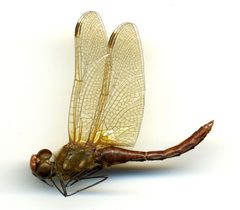
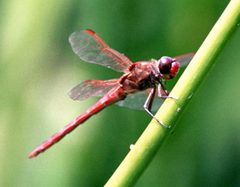
Sympetrum madidum, the red-veined meadowhawk, is a medium-sized in the Libellulidae. It is distinguished from by gold to red clouding of its wings and red wing . The ranges across western and northern North America, inhabiting shallow marshy ponds and lakes. are active from mid-June to mid-September, with some flying from April through September.
Pronunciation
How to pronounce Sympetrum madidum: /sɪmˈpɛtrəm məˈdɪdəm/
These audio files are automatically generated. While they are not always 100% accurate, they are a good starting point.
Identification
Distinguished from other Sympetrum by gold to red clouding of wings and red wing . Similar to cardinal meadowhawk (Sympetrum illotum), which has black at the wing bases, no black underside, and reddish legs. Naiads are extremely difficult to distinguish from striped meadowhawk (Sympetrum pallipes) naiads.
Images
Habitat
Shallow, marshy ponds and lakes. Naiads live in debris on the bottom of ponds and lakes and can develop in ephemeral sites.
Distribution
North America: western United States (Alaska, California, Colorado, Idaho, Iowa, Missouri, Montana, Nebraska, North Dakota, Oregon, Washington, Wyoming) and Canada (Alberta, British Columbia, Manitoba, Northwest Territories, Nunavut, Saskatchewan, Yukon).
Seasonality
Commonly active mid-June to mid-September; also reported flying from April to September in some areas.
Diet
feed on soft-bodied flying insects including mosquitoes, flies, small , mayflies, and flying ants or . Naiads feed on aquatic insects including mosquito larvae, other aquatic fly larvae, larvae, and freshwater shrimp; occasionally consume very small fish and tadpoles.
Life Cycle
: , naiad, . Female lays eggs in shallow lakes and ponds by dipping tip on water surface. Naiads emerge as adults at night.
Behavior
hunt flying insects from rocks or bare branches. Naiads are sit-and-wait that do not actively pursue prey. Adults bask on rocks to absorb heat early in the day, consistent with the name Sympetrum ('with rock').
Ecological Role
in both aquatic (naiad) and terrestrial () life stages. Naiads control of aquatic insect larvae and small aquatic organisms; adults prey on flying insects including mosquitoes.
Human Relevance
Considered beneficial due to on mosquitoes and other flying insects. Subject of citizen science monitoring through observation programs.
Similar Taxa
- Sympetrum illotum (cardinal meadowhawk)Similar appearance but distinguished by black at wing bases, absence of black underside, and reddish legs
- Sympetrum pallipes (striped meadowhawk)Naiads are extremely difficult to tell apart from red-veined meadowhawk naiads
More Details
Conservation Status
Appears to be relatively uncommon over most of its distribution. Not the most well-known of Sympetrum .
Sources and further reading
- BugGuide
- Wikipedia
- GBIF taxonomy match
- iNaturalist taxon
- NCBI Taxonomy
- Catalogue of Life
- Know Your Dragonflies! | Bug Squad
- Lovin' the Lavender | Bug Squad
- The Day That Dragonflies Sprang to Life | Bug Squad
- Beauties in the Bog - Buglife Blog - Buglife
- 🪲 Entomologizing w/ the WGNSS Entomology Group at Hughes Mountain Natural Area — 11 Oct 2025 | Beetles In The Bush
- Citizen Scientists Needed for the Migratory Dragonfly Partnership