
Erythrodiplax fervida
(Erichson, 1848)
Red-mantled Dragonlet
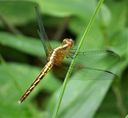
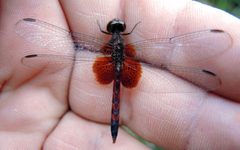
Erythrodiplax fervida, commonly known as the Red-mantled Dragonlet, is a small in the Libellulidae. The occurs in the Caribbean and South America, with records from Cuba, Colombia, and Mexico. It is one of five Antillean Erythrodiplax species found in Cuba. The last instar larva was formally described in 2007, filling a gap in the taxonomic knowledge of Cuban dragonflies. The IUCN lists the species as Least Concern with a stable .
Pronunciation
How to pronounce Erythrodiplax fervida: /ˌɛrɪθroʊˈdɪplæks ˈfɛrvɪdə/
These audio files are automatically generated. While they are not always 100% accurate, they are a good starting point.
Identification
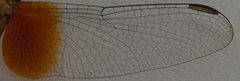
A small skimmer . likely exhibit the -typical characteristics of Erythrodiplax, including relatively broad wings and compact body form. The specific epithet "fervida" (Latin for burning, fiery) may refer to coloration, though adult color patterns are not detailed in available sources. The last instar larva has been formally described and can be distinguished from other Cuban Erythrodiplax by morphological characters detailed in the taxonomic literature.
Images
Distribution
Caribbean Sea region and South America. Specific localities include Cuba, Colombia (Barrancabermeja, Villavicencio in Meta Department), and Mexico (Oaxaca).
Life Cycle
Aquatic larval development in freshwater , as is typical for the Libellulidae. The final instar larva has been described. and period timing are not documented in available sources.
Ecological Role
Predatory , likely functioning as both aquatic in nymphal stages and aerial predator as . Specific ecological interactions have not been documented.
Similar Taxa
- Erythrodiplax bereniceBoth occur in saline coastal ; E. berenice is the only Odonata known to breed in marine salinities
- Erythrodiplax umbrataOverlapping distribution in Caribbean; both are small skimmers in the same
- Erythrodiplax justinianaAnother Cuban Erythrodiplax with which it shares and similar size
Sources and further reading
- BugGuide
- Wikipedia
- GBIF taxonomy match
- iNaturalist taxon
- Catalogue of Life
- Dragonfly meets spider, spider eats dragonfly: Seaside Dragonlet, Erythrodiplax Berenice, and daddy-long-legs, Pholcus spp. — Bug of the Week
- Erythrodiplax ana Archives - Entomology Today
- erythrodiplax-ana - Entomology Today
- Archive — Bug of the Week
- A New Dragonfly Species Discovered in Brazil
- Description of the last instar larva of Erythrodiplax fervida (Erichson, 1848) (Anisoptera: Libellulidae), with notes on the biology of the species