
Erythrodiplax
Brauer, 1868
Dragonlets
Species Guides
6- Erythrodiplax basifusca(plateau dragonlet)
- Erythrodiplax berenice(Seaside Dragonlet)
- Erythrodiplax fervida(Red-mantled Dragonlet)
- Erythrodiplax fusca(Red-faced Dragonlet)
- Erythrodiplax minuscula(little blue dragonlet)
- Erythrodiplax umbrata(band-winged dragonlet)
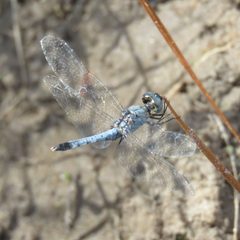
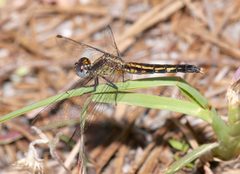
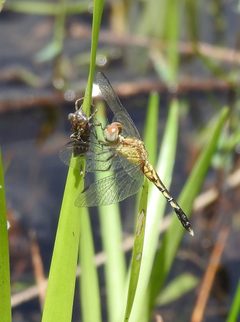
Erythrodiplax is a large Neotropical of small to medium-sized in the Libellulidae, commonly known as dragonlets. The genus contains numerous distributed across the Americas, with some members exhibiting unique ecological adaptations. Erythrodiplax berenice, the Seaside Dragonlet, is the only odonate known to develop in saline water, tolerating salinities up to 48%. Species within this genus display diverse reproductive , with males exhibiting territorial or satellite strategies and engaging in mate guarding during oviposition.
Pronunciation
How to pronounce Erythrodiplax: /ˌɛrɪˌθroʊdɪˈplæks/
These audio files are automatically generated. While they are not always 100% accurate, they are a good starting point.
Identification
Dragonlets are small to medium-sized skimmers in the Libellulidae. Specific identification to level requires examination of wing venation, abdominal patterning, and male secondary sexual characteristics. Some species exhibit striking ontogenetic color changes; for example, Erythrodiplax ana males transition from green/olive and in youth to completely black with age, developing blue pruinosity on the mesepisternum and abdominal segments 3-7. Females are typically more uniformly colored, often yellowish with brown wing spots. The is distinguished from other Libellulidae by a combination of structural characters including wing shape and genital , though precise identification often requires examination.
Images
Habitat
vary considerably among . Erythrodiplax berenice inhabits saline pools and coastal marshes along the Atlantic coast from Nova Scotia to Florida, the only odonate member capable of developing in marine water sources. Erythrodiplax abjecta occurs in Andean mountain habitats in Colombia. Erythrodiplax ana was discovered in palm swamp areas in southwestern Brazil. Many species occupy freshwater wetlands, ponds, and slow-moving waters typical of libellulid .
Distribution
Neotropical distribution spanning North, Central, and South America. Erythrodiplax berenice ranges along the Atlantic coast from Nova Scotia to Florida. Erythrodiplax abjecta is documented from the Colombian Andean Mountains. Erythrodiplax ana is known from Minas Gerais State, Brazil. The as a whole has broad distribution throughout the Neotropics with numerous across diverse biogeographic regions.
Life Cycle
Larval development occurs in aquatic . Erythrodiplax berenice nymphs develop in saline pools with salinities up to 48%, unique among Odonata. Erythrodiplax ana larvae have been reared in laboratory conditions, with the final instar described taxonomically. emerge and undergo maturation periods during which color changes may occur in some .
Behavior
Reproductive has been studied in several . Erythrodiplax abjecta males exhibit either territorial or satellite behavior between 10:00 and 14:30 hours. Tandem and copulation are brief and may occur perched or in . Males guard females during oviposition, either perched or hovering, to protect against rival males. males engage in sieges of perching or ovipositing females and mating pairs; successful besieging males may displace original males, take females in tandem, copulate, and assume guarding duties. Erythrodiplax berenice is notably lethargic compared to other , spending most time perching on vegetation with oriented upwind, a posture believed to assist with lift-off. This species shows little territorial defense.
Ecological Role
are aerial capturing small flying insects. Erythrodiplax berenice serves as prey for web-building spiders including pholcids in coastal . Larvae function as aquatic predators in their respective habitats, with E. berenice uniquely occupying saline .
Similar Taxa
- Other Libellulidae generaErythrodiplax can be distinguished from other skimmer by combinations of wing venation, genital structure, and in some by distinctive color patterns including ontogenetic changes in males. The saline-tolerant E. berenice is ecologically unique among odonates.
More Details
Ontogenetic color change
Erythrodiplax ana exhibits pronounced ontogenetic color change in males, transitioning from green/olive and when young to completely black with age, accompanied by development of blue pruinosity. This phenomenon may complicate field identification and has been documented through six-day recapture studies.
Saline tolerance uniqueness
Erythrodiplax berenice represents the only known member of order Odonata capable of completing development in saline water, with nymphs surviving salinities up to 48%. All other odonate nymphs require freshwater .
Sources and further reading
- BugGuide
- Wikipedia
- GBIF taxonomy match
- iNaturalist taxon
- NCBI Taxonomy
- Catalogue of Life
- Dragonfly meets spider, spider eats dragonfly: Seaside Dragonlet, Erythrodiplax Berenice, and daddy-long-legs, Pholcus spp. — Bug of the Week
- Erythrodiplax ana Archives - Entomology Today
- erythrodiplax-ana - Entomology Today
- Archive — Bug of the Week
- A New Dragonfly Species Discovered in Brazil
- Reproductive behavior of Erythrodiplax abjecta (Rambur, 1842) from Andean Mountains