
Vella fallax
(Rambur, 1842)
doodlebug
Species Guides
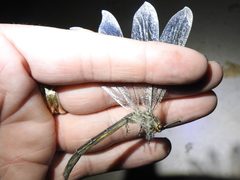
1Vella fallax is a of antlion in the Myrmeleontidae, found across the Caribbean, Central America, North America, and South America. are among the largest antlions, with wingspans reaching 100-120 millimeters or more. The species belongs to a containing three species, all characterized by their large size and attraction to lights. Two are recognized: Vella fallax fallax and Vella fallax texana.


Pronunciation
How to pronounce Vella fallax: /ˈvɛl.la ˈfæl.æks/
These audio files are automatically generated. While they are not always 100% accurate, they are a good starting point.
Identification
Distinguished from other antlion by its exceptionally large size; Vella have wingspans of 100-120 mm compared to typical antlion wingspans of 30-50 mm. The short, clubbed separate adults from superficially similar damselflies (Odonata), which have long, thread-like antennae. Among , V. fallax can be separated from V. americana and other Vella by geographic distribution and subtle wing pattern differences. The two differ in distribution: V. f. fallax occurs more broadly, while V. f. texana is restricted to Texas and surrounding regions.
Images
Habitat
Found in dry, sandy or powdery soil environments. Prime situations include areas at the base of trees, beneath rock overhangs, under bridges, dirt floors of old barns and sheds, and other situations that remain perpetually dry. are frequently attracted to artificial lights at night.
Distribution
Caribbean Sea, Central America, North America (southern United States), and South America. GBIF records specifically from Brazil (Ceará, Espírito Santo, Paraíba, Rio de Janeiro). The V. f. texana occurs in Texas and adjacent areas.
Seasonality
active during warmer months; frequently observed at lights during summer evenings. Specific not documented in available sources.
Life Cycle
Complete with , larva, pupa, and stages. Larva buries itself in soil and waits for prey. occurs in a sand-incorporated silken cocoon underground. Adults emerge from pupal cases.
Behavior
fly clumsily and are most often seen among tall grasses, especially at dusk. When alighting on vegetation, adults align themselves so precisely against stems or twigs as to become essentially invisible through . Larvae are sit-and-wait that do not construct pit traps. Adults of this are strongly attracted to lights at night.
Ecological Role
Predatory role in larval stage; larvae capture small arthropods. may serve as prey for other insects, spiders, and birds. Specific ecological interactions not documented.
Human Relevance
Occasionally encountered by entomologists and naturalists due to attraction to lights. No documented economic importance or pest status. Subject of interest due to large size relative to other antlions.
Similar Taxa
- Vella americanaAnother large Vella with similar size and ; distinguished by distribution and subtle wing pattern differences
- Myrmeleon speciesMuch smaller antlions (wingspans typically 30-50 mm); larvae construct characteristic pit traps, unlike Vella larvae
- Glenurus speciesLarge antlions with distinctive black, white, and pink wingtip patterns not present in Vella
- Damselflies (Zygoptera)Superficially similar form but possess long, thread-like versus short, clubbed antennae of antlions; also differ in wing venation and resting posture
More Details
Subspecies
Two recognized: Vella fallax fallax (Rambur, 1842) and Vella fallax texana (Hagen, 1887). The latter is restricted to Texas and surrounding regions.
Conservation Status
Not evaluated by IUCN; appears to be widespread and not of conservation concern based on broad distribution.
Taxonomic History
First described by Rambur in 1842. The has been subject to limited modern taxonomic study.
Sources and further reading
- BugGuide
- Wikipedia
- GBIF taxonomy match
- iNaturalist taxon
- NCBI Taxonomy
- Catalogue of Life
- Meloidae Holdings | Entomology Research Museum
- Bug Eric: "Doodlebugs" (Antlions)
- Dark days for the Environment across Europe - Buglife Blog - Buglife
- Honey Locust Borer | Beetles In The Bush
- Conservation Translocations: It’s Not Just Beavers - Buglife Blog - Buglife
- Uncategorized | Blog - Part 29