
Vella americana
(Drury, 1773)
Vella americana is a large antlion in the Myrmeleontidae, notable for being among the largest antlions in North America with wingspans exceeding 100 mm. Unlike pit-digging antlions of the Myrmeleon, larvae of Vella bury themselves just below the soil surface and wait for prey. Two distinctive larval have been documented: 'surface travel,' where larvae move across exposed substrates to relocate, and 'sand-blast,' rapid expulsion of sand from the mouth to clear debris or excavate. Adults are frequently attracted to lights at night.
Pronunciation
How to pronounce Vella americana: /ˈvɛl.lə əˌmɛr.ɪˈkɑːnə/
These audio files are automatically generated. While they are not always 100% accurate, they are a good starting point.
Identification
are distinguished from by their short, clubbed (versus long, thread-like antennae in damselflies). Among antlions, Vella americana is recognized by its exceptional size—wingspans of 100–120 mm or more, substantially larger than most Myrmeleontidae. The Vella contains three ; specific characters distinguishing V. americana from are not detailed in available sources. Larvae lack the pit-digging of Myrmeleon and instead bury themselves just below the surface.
Images
Appearance
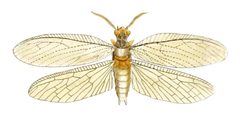
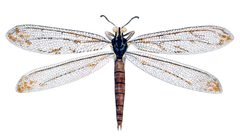
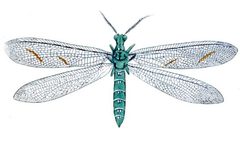
are large, delicate insects with long, slender bodies and broad, lacy wings. The wingspan reaches 100–120 mm or more, making this one of the largest North American antlions. Adults possess short, thick, clubbed that distinguish them from superficially similar . Wings typically display dark spots and speckles that provide cryptic camouflage. When at rest, adults align themselves flat against substrates, rendering them nearly invisible. Larvae are robust, wrinkled, and studded with spines, with long, hooked characteristic of antlions.
Habitat
Sandy substrates suitable for burrowing. Larvae are found in dry, sandy soils where they bury themselves just beneath the surface. The 'surface travel' indicates larvae are periodically active on exposed substrates when relocating.
Distribution
North America, specifically in the southern third of the United States according to one source. GBIF records confirm presence in North America.
Seasonality
are frequently attracted to lights at night, suggesting activity. Specific seasonal timing of adult or larval activity periods are not documented in available sources.
Life Cycle
Larval stage is the primary documented phase. Larvae bury themselves in sand and wait for prey. occurs inside a silken capsule spun underground, with sand grains incorporated into the cocoon—this is inferred from general Myrmeleontidae and the source's description of antlion pupation, though not explicitly confirmed for V. americana. biology is poorly documented.
Behavior
Larvae exhibit two distinctive : 'surface travel'—moving across the surface to new locations rather than burrowing continuously; and 'sand-blast'—rapid expulsion of sand from the mouth to clear debris or excavate. These behaviors were formally described in a 2017 study. are and attracted to lights. When at rest, adults demonstrate remarkable by aligning themselves flat against grass stems or twigs, becoming essentially invisible.
Human Relevance
are frequently attracted to artificial lights at night, making them observable in residential areas. The large size and distinctive appearance of adults may attract attention from entomologists and naturalists.
Similar Taxa
- MyrmeleonPit-digging antlions; larvae construct characteristic funnel-shaped traps in fine soil, unlike Vella which buries itself just below the surface without pit construction
- ScotoleonAnother North American antlion ; have elongated male with bracket-like claspers, and are generally smaller than Vella
- GlenurusNorth American antlion with spectacular black, white, and pink wingtips; distinguished from Vella by distinctive wing coloration
Sources and further reading
- BugGuide
- Wikipedia
- GBIF taxonomy match
- iNaturalist taxon
- Catalogue of Life
- Bug Eric: "Doodlebugs" (Antlions)
- Deerly departed: food for flesh-recycling carrion beetles - Margined carrion beetle, Oiceoptoma noveboracense, and American carrion beetle, Necrophila americana — Bug of the Week
- As a Watershed is Urbanized, Damselflies Show Declines
- Silphidae | Beetles In The Bush
- Dark days for the Environment across Europe - Buglife Blog - Buglife
- Explorer or Wallflower? Study Shines Light on Cockroach Personalities
- Description of Two New Surface Behaviors in the Antlion Vella americana Drury (Neuroptera: Myrmeleontidae)