
Swammerdamia pyrella
(de Villiers, 1789)
Little Ermel, Rufous-tipped Swammerdamia Moth
A small ermine moth (Yponomeutidae) with a wingspan of 10–13 mm, distributed across Europe, North America, and Japan. fly in two from late April to August. Larvae feed on Rosaceae fruit trees, initially mining leaves then feeding externally while tying leaf edges with silk to form protective 'boats'. The serves as to a diverse and is subject to significant natural .
Pronunciation
How to pronounce Swammerdamia pyrella: //swæmərˈdeɪmiə paɪˈrɛlə//
These audio files are automatically generated. While they are not always 100% accurate, they are a good starting point.
Identification
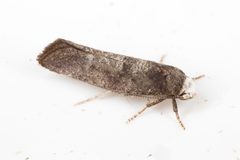
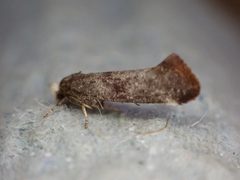
Distinguished from similar Swammerdamia by the complete dark purplish fuscous fascia on the forewing before the middle (not interrupted or broken), combined with the whitish anteapical costal spot and dark coppery-fuscous cilia. The forewing lacks the strong metallic sheen seen in some . Larval 'boats' formed from tied leaf edges are characteristic but not exclusive; confirmation requires examination.
Images
Appearance
Wingspan 10–13 mm. white or whitish ochreous. dark fuscous with whitish speckling. Forewings fuscous with faint purplish tinge, densely irrorated with dark fuscous and irregularly sprinkled with whitish; a dark purplish fuscous complete fascia before the middle; a whitish anteapical costal spot; cilia dark coppery-fuscous. Hindwings grey. Larva pale yellow with dark red-brown line; segments 4–12 with pale brown bands; head brown with blackish sides.
Habitat
Fruit orchards, particularly those with limited chemical pest management; monastery gardens with mixed fruit trees, vegetables, and ornamental plantings; newly established apple orchards. Associated with trees bearing Rosaceae : apple (Malus domestica), pear (Pirus spp.), plum and cherry (Prunus spp., Cerasus avium), rowan (Sorbus spp.), and hawthorn (Crataegus spp.).
Distribution
Europe (common and widespread, including Belgium, Netherlands, Poland, UK), North America, and Japan. Specific study documented in eastern Poland (Lublin region).
Seasonality
Two per year. active from late April to August; based on Belgian and Dutch records, with potential regional variation.
Diet
Larvae feed on leaves of Rosaceae fruit trees: Malus domestica (apple), Cerasus avium (cherry), Prunus spp. (plum/cherry), Pirus spp. (pear), Sorbus spp. (rowan), and Crataegus spp. (hawthorn). First instars are endophagous leaf miners; later instars feed exophagously on leaf and mesophyll while leaving and lower intact.
Host Associations
- Malus domestica - larval food plantapple
- Cerasus avium - larval food plantcherry
- Prunus spp. - larval food plantplum, cherry
- Pirus spp. - larval food plantpear
- Sorbus spp. - larval food plantrowan
- Crataegus spp. - larval food planthawthorn
- Gelis agilis - hyperparasitoid, 94% of secondary in Polish study
- Triclistus pallipes - primary , effective natural regulator
- Dibrachys cavus - primary , effective natural regulator
- Chrysocharis aquilegiae - newly reported from this
- Catolaccus ater - newly reported from this
- Eupelmus urozonus - newly reported from this
Life Cycle
Two annually. First generation: larvae mine leaves then feed externally, pupating in white spindle-like cocoons on leaves. Second generation: larvae overwinter in bark crevices on tree trunks, pupating in similar white spindle-like cocoons with thread-like insets; emerge after winter. Overall parasitization of cocoons averaged 30.4% across 2001–2003 in Poland, varying significantly by year (47.4% in 2001, 13.5% in 2002, 12.7% in 2003).
Behavior
Larvae spin silk to tie leaf edges together, forming characteristic 'boat' structures that provide shelter during feeding. occurs in white spindle-like cocoons with distinctive thread-like insets, located on leaves for the first or in bark crevices on trunks for the generation.
Ecological Role
Herbivore and minor pest of fruit trees. Serves as for a diverse of 25 parasitic Hymenoptera , supporting complex trophic webs with hyperparasitoids dominating. Subject to substantial natural ; Triclistus pallipes and Dibrachys cavus function as key regulators.
Human Relevance
Minor pest of commercial and ornamental fruit trees, particularly in unsprayed or organically managed orchards. Damage is generally limited and are often naturally controlled by . The has been studied as a model for parasitoid and potential.
Similar Taxa
- Swammerdamia caesiellaSimilar size and general appearance, but forewing fascia typically interrupted or less complete; overlap on Rosaceae but larval shelters differ in construction details.
- Swammerdamia compunctellaOverlapping distribution and plants; distinguished by forewing pattern with more distinct whitish speckling and different fasciation.
- Yponomeuta spp.Related ermine moths with similar larval web-spinning , but are generally larger with more extensive white forewing markings and larvae feed gregariously in extensive webs rather than individual leaf boats.