
Swammerdamia caesiella
(Hübner, 1796)
Birch Ermel
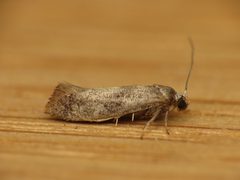
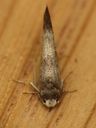
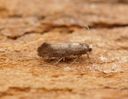
Swammerdamia caesiella is a small ermine moth in the Yponomeutidae, commonly known as the Birch Ermel. It has a broad distribution across Europe, Asia, and North America, where it may have been introduced. The is , with active in spring and late summer. Larvae specialize on birch foliage.
Pronunciation
How to pronounce Swammerdamia caesiella: //swæm.ərˈdeɪ.mi.ə siː.siˈɛl.lə//
These audio files are automatically generated. While they are not always 100% accurate, they are a good starting point.
Identification
The reduced antemedian fascia (appearing as two spots rather than a continuous band) and the paired white costal spots separated by a dark spot distinguish this from . The coppery-tinged cilia with dark lines is also distinctive. In North America, separation from the native Swammerdamia lutarea requires examination of genitalia.
Images
Habitat
Associated with birch woodland and areas where Betula occur, including both native forests and planted stands.
Distribution
Native to most of Europe, extending eastward through Asia to Japan. Present in North America, where it is possibly introduced.
Seasonality
: on wing May to June, then again in August. Two per year.
Diet
Larvae feed on Betula (birch).
Host Associations
- Betula - larval foodplant
Life Cycle
Two per year. stage not specified in available sources.
Ecological Role
Herbivore on birch; contributes to leaf damage in birch , though impact is generally minor.
Human Relevance
Minor forestry pest on birch; of interest to lepidopterists due to its distinctive markings and wide distribution.
Similar Taxa
- Swammerdamia lutareaSimilar size and general appearance; distinguished by genitalic characters and more complete antemedian fascia in S. lutarea.
- Other Swammerdamia speciesPattern elements of forewing fascia and spot arrangement differ; S. caesiella has uniquely reduced antemedian fascia.
More Details
Taxonomic Note
Authorship sometimes cited as (Hübner, 1796) or Stainton, 1870; the latter is treated as a synonym in modern sources.
North American Status
Presence in North America is documented, but whether it represents a natural Holarctic distribution or human-mediated introduction remains unresolved.