
Argyresthia thuiella
(Packard, 1871)
arborvitae leafminer, thuja mining moth, American thuja shoot moth
Argyresthia thuiella is a micro- in the Argyresthiidae, commonly known as the arborvitae leafminer. Native to North America, it has been introduced to Europe multiple times since 1971. The develops one annually, with larvae mining the foliage and twigs of Thuja and Chamaecyparis species. are active from May to July and have a wingspan of approximately 8 mm.
Pronunciation
How to pronounce Argyresthia thuiella: /ɑːrˈdʒɪrɛsthiə θuːiˈɛlə/
These audio files are automatically generated. While they are not always 100% accurate, they are a good starting point.
Identification
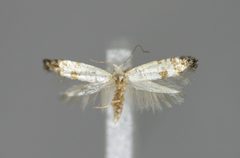
The small size (8 mm wingspan), white ground color with metallic transverse banding, and association with Thuja or Chamaecyparis plants are key identifying features. Definitive identification often requires examination of genitalia or chaetotaxy. The can be distinguished from Pulicalvaria thujaella, another leafminer on eastern white cedar, by morphological details and larval mine characteristics.
Images
Appearance
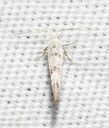
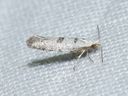
are small with a wingspan of about 8 mm. The body is slender and typically white with broad, transverse metallic stripes—characteristic of many Argyresthia .
Habitat
Stands and plantings of Thuja occidentalis and related Cupressaceae; includes natural forests, ornamental plantings, and urban landscapes with arborvitae or false cypress.
Distribution
Native to southeastern Canada and northeastern United States, ranging south to North Carolina and west to Missouri and Manitoba. Isolated in British Columbia. Introduced to Europe: Netherlands (1971), Germany (1975), Austria (1976), with subsequent spread to Belgium, Switzerland, France, Scandinavia, and central Europe.
Seasonality
on wing from May to July depending on location; one annually.
Diet
Larvae are leafminers feeding internally on foliage and twigs of Thuja occidentalis, Thuja plicata, and Chamaecyparis lawsoniana (Cupressaceae).
Host Associations
- Thuja occidentalis - larval primary ; eastern white cedar
- Thuja plicata - larval western red cedar
- Chamaecyparis lawsoniana - larval Lawson's cypress, Port Orford cedar
- Chamaecyparis - larval false cypress generally
Life Cycle
Overwinters as larva inside twigs. occurs within the twig the following spring. emerge and are active from May to early July. One per year.
Behavior
Larvae mine inside twigs and foliage, feeding between layers of plant tissue. occurs within the plant, not in soil or leaf litter.
Ecological Role
Herbivorous leafminer; support . Substantial mortality from parasitoids has been documented, though winterkill can exceed parasitoid impact in severe winters. At high densities, may contribute to nutrient cycling through premature leaf abscission.
Human Relevance
Considered a pest of ornamental conifers. Damage is primarily aesthetic, though heavy may cause tree stress or damage. Control methods have been investigated in nursery and landscape settings.
Similar Taxa
- Pulicalvaria thujaellaAlso a leafminer on Thuja occidentalis; distinguished by (Gelechiidae vs. Argyresthiidae), morphological details, and mine characteristics
- Argyresthia trifasciataCongeneric with similar and ; distinguished by specific chaetotaxy and associations
More Details
Population Dynamics
Studies in Ontario documented highly variable mortality, with winterkill ranging from 6.8% to 62.9% between years. increased from 1975 to 1976 but declined substantially from 1976 to 1977, likely due to increased winter mortality.
Taxonomic History
Originally described as Bucculatrix thuiella Packard, 1871; later transferred to Argyresthia. placement has shifted historically between Yponomeutidae and Argyresthiidae; currently accepted in Argyresthiidae.
Introduction History
European introductions were deliberate or accidental, with three documented founding events: Netherlands (1971), Germany (1975), and Austria (1976). The has since established and spread across multiple European countries.
Sources and further reading
- BugGuide
- Wikipedia
- GBIF taxonomy match
- NCBI Taxonomy
- Catalogue of Life
- Bug Eric: New Mexico Night Bugs
- Morphology, Biology and Control Possibilities of Two Argyresthia species - A. thuiella and A. trifasciata (Lepidoptera: Argyresthiidae)
- FACTORS AFFECTING THE MORTALITY OF LEAFMINERS ARGYRESTHIA THUIELLA AND PULICALVARIA THUJAELLA (LEPIDOPTERA: YPONOMEUTIDAE AND GELECHIIDAE) ON EASTERN WHITE CEDAR, IN ONTARIO