
Argyresthiidae
Bruand, 1850
Shiny Headstand Moths, Shiny Head-standing Moths
Genus Guides
1- Argyresthia(Argents)
is a of small commonly known as . Formerly treated as a of Yponomeutidae, it is now recognized as a distinct family by many authorities. Members are minute moths, typically 3–15 mm in length, with metallic markings on white or pale backgrounds. The family includes approximately 150 described , primarily in the Argyresthia. Larvae are internal feeders, mining needles of conifers or tissues of broadleaved plants. Several species are economically significant pests of fruit crops and ornamental conifers.
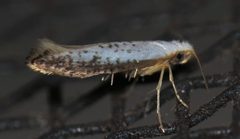
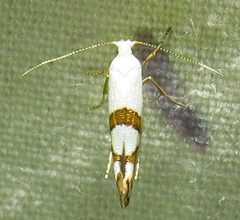
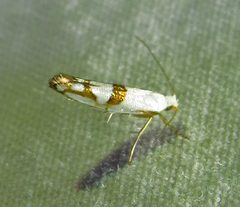
Pronunciation
How to pronounce Argyresthiidae: /ɑːrˌdʒɪrɛsˈθɪɪdiː/
These audio files are automatically generated. While they are not always 100% accurate, they are a good starting point.
Identification
Minute (3–15 mm wingspan) with distinctive metallic coloration. Most have white or pale wings marked with broad, transverse metallic stripes in gold, , or silver. The Argyresthia, which contains the majority of species, shows this pattern consistently. often appears shiny due to reflective scaling. simple, not strongly modified. At rest, some species adopt a characteristic head-down posture, contributing to the . Genitalia dissection is typically required for species-level identification.
Images
Habitat
Associated with plants: coniferous forests for needle-mining ; orchards, woodlands, and urban plantings for broadleaf-associated species. Ornamental conifer plantings support of Thuja- and Juniperus-feeding species.
Distribution
Circumpolar distribution in northern regions, with strong representation in Fennoscandia, northern Europe, and North America. Documented from: Austria, Belgium, Britain, Croatia, Czech Republic, Denmark, France, Germany, Hungary, Netherlands, Norway, Poland, Slovenia, Sweden, Switzerland, Turkey, United States (including Vermont), and Guatemala (Neotropical records sparse).
Seasonality
periods vary by and latitude. A. thuiella: June to early July. A. trifasciata: mid-May to early June. A. conjugella: timing associated with , with to apple orchards during years of rowan crop failure. Most temperate species appear to be .
Diet
Larvae are internal tissue feeders. Conifer-feeding mine needles and twigs of Cupressaceae (Thuja, Chamaecyparis, Juniperus). Broadleaf-feeding species mine fruits, seeds, or shoots; A. conjugella feeds within apple fruits after -switching from rowan.
Host Associations
- Sorbus aucuparia - main mountain ash/rowan; principal of A. conjugella
- Malus - secondary apple; invaded when rowan crops fail, causing orchard damage in Fennoscandia
- Thuja occidentalis - northern white cedar
- Thuja plicata - western red cedar
- Chamaecyparis lawsoniana - Port Orford cedar/Lawson's cypress
- Juniperus virginiana - eastern red cedar
- Juniperus chinensis - Chinese juniper
- Juniperus sabina - savin juniper
- Juniperus squamata - flaky juniper
- Juniperus horizontalis - creeping juniper
- Juniperus - inferred believed of A. impura
Life Cycle
Internal feeder throughout larval stage. site varies: within twig (A. thuiella) or in ground debris under host tree (A. trifasciata). stage varies by : as larva inside twig (A. thuiella) or as mature larva/pupa. One annually () for studied species.
Behavior
Female A. conjugella produces (Z)-11-hexadecenyl acetate; males strongly attracted to this compound, with attraction inhibited by presence of (Z)-11-hexadecen-1-ol. A. conjugella exhibits facultative -switching: remains on primary host Sorbus aucuparia when fruit abundant, but migrates to apple orchards during rowan intermast years when primary host fails to set fruit. This causes sporadic but severe apple damage in Fennoscandia.
Ecological Role
Several function as pests in managed : A. conjugella is the most important apple pest in Scandinavia; A. thuiella and A. trifasciata cause aesthetic damage to ornamental conifers with potential for tree injury under heavy . Native species occupy conifer and broadleaf feeding as internal tissue miners. Some species appear to be naturally rare with restricted distributions (e.g., A. impura).
Human Relevance
A. conjugella is a major economic pest of apple in Fennoscandia, capable of destroying entire crops during rowan intermast years. -based monitoring systems using (Z)-11-hexadecenyl acetate have been developed for detection and management. Ornamental conifer pests A. thuiella and A. trifasciata require monitoring in horticultural settings. Some are subjects of taxonomic conservation concern due to rarity and restricted ranges.
Similar Taxa
- YponomeutidaeFormerly treated as Argyresthiinae; distinguished by 's more metallic coloration, conifer/broadleaf mining habits versus external feeding, and phylogenomic placement as separate
- PlutellidaeClosest phylogenetic relative based on mitochondrial analysis; distinguished by different and larval feeding habits (Plutellidae larvae are external leaf feeders, not internal miners)
- EthmiidaeSimilar small size and pale coloration with dark markings; Ethmiidae larvae feed externally on Boraginaceae and related , not as internal miners
- GelechiidaeSimilar minute size and some metallic ; Gelechiidae typically have more varied wing patterns, different resting postures, and larvae usually feed externally or in webs rather than as internal miners
Sources and further reading
- BugGuide
- Wikipedia
- GBIF taxonomy match
- iNaturalist taxon
- NCBI Taxonomy
- Catalogue of Life
- Bug Eric: New Mexico Night Bugs
- Novel insight into lepidopteran phylogenetics from the mitochondrial genome of the apple fruit moth of the family Argyresthiidae
- The globally rare Argyresthia impura (Staudinger, 1879) adventive in the Netherlands and Belgium, with notes on synonymy, biology, and distribution (Lepidoptera: Argyresthiidae)
- Morphology, Biology and Control Possibilities of Two Argyresthia species - A. thuiella and A. trifasciata (Lepidoptera: Argyresthiidae)
- Three new species of the genus Argyresthia Hübner, [1825] from Guatemala, with notes on host plant evolution and Nearctic taxa (Lepidoptera: Argyresthiidae)
- Novel insight in Lepidoptera phylogenetics from the mitochondrial genome of the apple fruit moth of the family Argyresthiidae
- Novel insight into lepidopteran phylogenetics from the mitochondrial genome of the apple fruit moth of the family Argyresthiidae
- Sex pheromone of apple fruit moth Argyresthia conjugella (Lepidoptera: Argyresthiidae)