
Bucculatrix
Zeller, 1839
ribbed cocoon-maker moths
Species Guides
42- Bucculatrix adelpha
- Bucculatrix agnella
- Bucculatrix ainsliella(Oak Skeletonizer Moth)
- Bucculatrix albertiella(Oak Ribbed Casemaker)
- Bucculatrix ambrosiaefoliella
- Bucculatrix anaticula
- Bucculatrix angustata(Narrow Bucculatrix)
- Bucculatrix canadensisella(Birch Skeletonizer)
- Bucculatrix ceanothiella
Bucculatrix is a of small in the Bucculatricidae, commonly known as ribbed cocoon-maker moths. Larvae of many are leaf miners on specific plants, with some species exhibiting —shifting from leaf mining in early instars to leaf skeletonization in later instars. The genus has a distribution with species described from all major continents.

Pronunciation
How to pronounce Bucculatrix: /ˌbʌk.jʊˈlæ.trɪks/
These audio files are automatically generated. While they are not always 100% accurate, they are a good starting point.
Identification
Identification to level typically requires examination of male and female genitalia, as external can be subtle and variable. using COI sequences is increasingly used to distinguish cryptic species. Some species can be tentatively recognized by plant association and larval mine morphology, though this requires rearing confirmation.
Images
Appearance
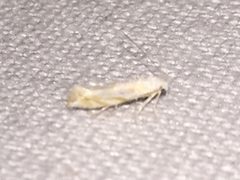
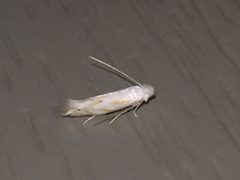
are small with narrow, wings. Coloration varies by , ranging from pale ochreous grey to brown or white with dark markings. Males of some species have nearly monochrome forewings while females may show more conspicuous patterning. Wing patterns often include longitudinal striations or small dark spots.
Habitat
are strongly tied to plant distribution. occur in diverse environments including coastal deserts, temperate forests, agricultural areas, and urban settings. Specific habitat requirements vary dramatically by species depending on host plant .
Distribution
distribution with recorded from North America, South America, Europe, Asia, Africa, and Oceania. Specific records include: northern Chile (Azapa Valley), Sicily and Sardinia, Latvia, Finland, mainland China, Japan (Ogasawara Islands), and widespread across the United States.
Seasonality
periods vary by and latitude. In temperate regions, activity is typically spring through summer. The City Nature Challenge observations in Kansas City (late April) document adults active during this period.
Diet
Larvae feed on leaf tissue of specific plants. Documented hosts include: Baccharis salicifolia (Asteraceae), Crataegus pinnatifida (Rosaceae), Gossypium australe (Malvaceae), Hibiscus (Malvaceae), and various Asteraceae. First through third instars are typically leaf miners; fourth and fifth instars may shift to leaf skeletonization in hypermetamorphic .
Host Associations
- Baccharis salicifolia - /skeletonizer of B. mirnae in Chile
- Crataegus pinnatifida - of B. crataega in China
- Gossypium australe - native cotton in Australia; of B. gossypii
- Hibiscus - leaf feeder of B. flavimaculata in Japan
- Aster tripolium - of B. maritima; contrasted with B. latviaella which avoids this plant
Life Cycle
Larvae typically have five instars. Some exhibit with ontogenetic shift in feeding : early instars (1-3) are leaf miners feeding within leaf tissue, while late instars (4-5) become leaf skeletonizers feeding externally on leaf surfaces. occurs in a distinctive ribbed cocoon, giving the group its .
Behavior
Larvae construct serpentine or blotch mines in leaves during early instars. Later instars may abandon mining to feed externally. are and attracted to light. Some show localized induced resistance effects on host plants, though this does not appear to affect oviposition behavior.
Ecological Role
Leaf miners and skeletonizers that can significantly impact plant . Serve as hosts for , including braconids in the Rhysipolinae (e.g., Pseudavga flavicoxa parasitizing B. thoracella). Some are economically important pests of agricultural crops.
Human Relevance
Some are agricultural pests. Bucculatrix gossypii is a significant folivore on native cotton in Australia. Bucculatrix thurberiella (cotton leaf perforator) is a documented pest species with research on reproductive . The is frequently encountered in citizen science projects like the City Nature Challenge, contributing to biodiversity documentation.
Similar Taxa
- LyonetiidaeSome authors place Bucculatricidae as a of Lyonetiidae; both contain small leaf-mining with similar
- Phyllocnistis (Gracillariidae)Similar leaf-mining habit and small size, but Bucculatrix larvae typically have five instars with versus Phyllocnistis with four instars and different mine
More Details
Taxonomic placement
Bucculatricidae has been treated as a of Lyonetiidae by some authors, but is now generally recognized as a distinct family within Gracillarioidea.
Species diversity
The contains numerous described with ongoing taxonomic work; recent descriptions include B. mirnae (Chile), B. brunnella (Italy), B. latviaella (Latvia), B. flavimaculata (Japan), and B. crataega (China).
Sources and further reading
- BugGuide
- GBIF taxonomy match
- iNaturalist taxon
- NCBI Taxonomy
- Catalogue of Life
- Bug Eric: City Nature Challenge 2023 Recap
- Bug Eric: City Nature Challenge 2024 Recap
- Bug Eric: 2025 City Nature Challenge Recap for Kansas City Metro
- <i>Bucculatrix latviaella</i> sp. n. aus Lettland (Lepidoptera, Bucculatricidae)
- Bucculatrix brunnella sp. n. (Lepidoptera, Bucculatricidae) from Sicily and Sardinia
- A new species of Bucculatrix Zeller (Lepidoptera: Bucculatricidae) associated with Baccharis salicifolia (Asteraceae) in northern Chile
- A new Hibiscus-feeding species of Bucculatrix (Bucculatricidae) from the Ogasawara Islands, Japan
- Influence of Several Biotic Factors on Reproduction of Bucculatrix thurberiella1, 2
- Bucculatrix crataega sp. nov. (Lepidoptera: Bucculatricidae), a leaf miner on Crataegus, representing the first formally named species of the family from mainland China
- Induced resistance of Gossypium australe against its most abundant folivore, Bucculatrix gossypii
- Figures 9–12 from: Shaw MR, Sims I (2015) Notes on the biology, morphology, nomenclature and classification of Pseudavga flavicoxa Tobias, 1964 (Hymenoptera, Braconidae, Rhysipolinae), a genus and species new to Britain parasitizing Bucculatrix thoracella (Thunberg) (Lepidoptera, Bucculatricidae). Journal of Hymenoptera Research 42: 21-32. https://doi.org/10.3897/JHR.42.8935