
Bucculatrix ainsliella
Murtfeldt, 1905
Oak Skeletonizer Moth, Oak Leaf Skeletonizer
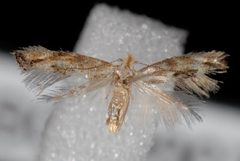
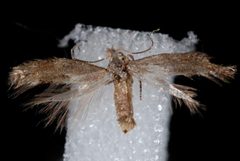
Bucculatrix ainsliella is a micromoth in the Bucculatricidae, described by Mary Murtfeldt in 1905. It is native to North America and has been introduced to Europe, with first records from the Netherlands and Belgium in 2011. The is notable for its distinctive larval feeding on oak leaves, progressing from internal leaf mining to external skeletonization.
Pronunciation
How to pronounce Bucculatrix ainsliella: /ˌbʌkjuˈleɪtrɪks eɪnˈzliːɛlə/
These audio files are automatically generated. While they are not always 100% accurate, they are a good starting point.
Identification
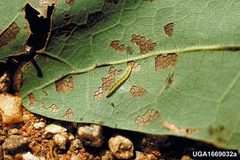
are extremely small (7–8 mm wingspan) and require microscopic examination or genitalia dissection for reliable identification to . The Bucculatrix is characterized by narrow, wings and a distinctive resting posture. Larvae are more readily identified by their feeding pattern: initial serpentine leaf mines on oak, followed by external feeding that skeletonizes the leaf surface, leaving intact. The ribbed cocoon is spun on the leaf surface or bark, a trait shared with other Bucculatrix species.
Images
Habitat
Associated with oak-dominated forests and woodlands. Larval is explicitly oak foliage. habitat requirements are poorly documented but presumably remain in or near oak-containing areas.
Distribution
Native to northern United States, ranging south to North Carolina and Mississippi, and southern Canada including British Columbia. Introduced to Europe: first detected in Netherlands and Belgium in 2011. GBIF records confirm established presence in Belgium (Flemish and Walloon regions).
Seasonality
have been recorded between February and August, with timing varying by geographic location. This extended period suggests possible multiple or regional phenological variation, though specific generation counts are not documented.
Diet
Larvae feed exclusively on Quercus (oak) . Early instars are leaf miners, creating internal feeding tunnels; later instars feed externally, consuming leaf tissue between and producing characteristic skeletonized leaves. feeding habits are not documented.
Host Associations
- Quercus - larval food plantMultiple oak ; specific not enumerated in sources
Life Cycle
Complete with four life stages. are laid on oak leaves. Larvae pass through two distinct feeding phases: initial endophytic leaf-mining, then ectophytic skeletonizing. occurs in a ribbed cocoon, typically attached to leaves or bark. Number of per year is not established; the extended period (February–August) may indicate bivoltinism or regional variation.
Behavior
Larvae exhibit a behavioral shift during development: early instars are concealed feeders inside leaf tissue, while later instars feed exposed on the leaf surface. This transition is characteristic of the . are presumably or based on traits, though specific activity patterns are not documented for this .
Ecological Role
As a oak herbivore, larvae contribute to leaf litter production and nutrient cycling in oak . impacts on trees are likely minimal under normal conditions given the 's small size and scattered distribution. The serves as prey for including birds and .
Human Relevance
Minor economic or ornamental concern when abundant, due to visible leaf damage on oak trees. The is more significant as a documented case of transatlantic introduction, with European records since 2011 demonstrating human-mediated , likely via horticultural trade of oak material.
Similar Taxa
- Other Bucculatrix speciesNearly identical ; require microscopic examination or larval association for differentiation. Many Bucculatrix are on other plant .
- Phyllonorycter spp. (Gracillariidae)Similar leaf-mining larvae on oaks, but Phyllonorycter typically create blotch mines on leaf undersides and do not transition to external skeletonizing feeding.
- Cameraria spp. (Gracillariidae)Oak leaf miners with blotch mine ; differ in mine shape and lack the external skeletonizing phase.