
Bucculatrix canadensisella
Chambers, 1875
Birch Skeletonizer
Bucculatrix canadensisella, commonly known as the birch skeletonizer, is a minute in the Bucculatricidae. The was described by V.T. Chambers in 1875 and is distributed across much of North America. Larvae are leaf miners on birch species, while are active from spring through late summer depending on location.
Pronunciation
How to pronounce Bucculatrix canadensisella: /bʊk.jʊˈlæ.trɪks kəˌneɪdənˈsɪsɛl.ə/
These audio files are automatically generated. While they are not always 100% accurate, they are a good starting point.
Identification
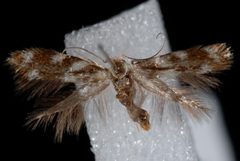
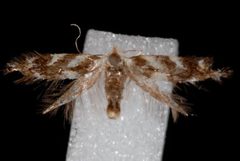
The combination of minute size (7–8.5 mm wingspan), narrow wings, and association with Betula plants distinguishes this from other small . are most readily identified by their and host association; definitive identification typically requires genitalia examination or molecular confirmation. Similar Bucculatrix species occur on different host plants or in different geographic regions.
Images
Appearance
are extremely small with a wingspan of 7–8.5 mm. The exhibits the typical form of Bucculatrix: narrow, wings and a slender body. Coloration is generally inconspicuous, consistent with the cryptic appearance common to this of ribbed cocoon-making moths.
Habitat
Associated with birch-dominated including forests, woodlands, and riparian corridors where Betula occur. Larval habitat is within birch leaves; are found in the vicinity of plants.
Distribution
North America. Canada: New Brunswick to British Columbia, Nova Scotia, Prince Edward Island, plus Alberta, Manitoba, and Saskatchewan. United States: New York, New Jersey, Michigan, Wisconsin, Minnesota, Pennsylvania, North Carolina, Tennessee, Kentucky, and Colorado.
Seasonality
have been recorded from April to September. Peak activity occurs between June and July in most locations, with timing varying by latitude and local climate conditions.
Diet
Larvae feed on Betula , including Betula nigra (river birch), Betula lutea (yellow birch), and Betula occidentalis (water birch). Larvae are leaf miners, feeding internally within birch leaves. feeding habits are not documented.
Host Associations
- Betula nigra - larval river birch
- Betula lutea - larval yellow birch
- Betula occidentalis - larval water birch
Life Cycle
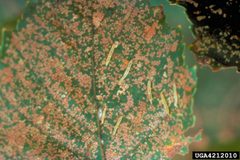
Complete with leaf-mining larval stage. Larvae mine the leaves of birch . The "skeletonizer" refers to the feeding damage pattern, though Bucculatrix larvae typically form blotch mines or linear mines rather than true skeletonization. occurs in a ribbed cocoon, characteristic of the . are active in spring and summer; multivoltine or patterns vary by region but are not well documented.
Behavior
are and have been attracted to light. Larvae are endophagous leaf miners, feeding within birch leaf tissue.
Ecological Role
As a herbivore on Betula, larvae contribute to nutrient cycling through leaf damage and serve as a food source for and . The is part of the diverse of Lepidoptera associated with birch .
Human Relevance
Minor economic significance as a birch pest; leaf mining damage is generally cosmetic rather than causing serious tree mortality. The is documented in citizen science platforms including iNaturalist.
Similar Taxa
- Other Bucculatrix speciesMany are morphologically similar and require examination of genitalia or plant association for separation. B. canadensisella is distinguished by its association with Betula and its North American distribution.
- Nepticulidae (microlepidopteran leaf miners)Similar minute size and leaf-mining habit, but belong to a different with different and larval mine patterns.
More Details
Taxonomic history
First described by Vactor Tousey Chambers in 1875. The epithet 'canadensisella' reflects its Canadian type locality and distribution.
Cocoon structure
Like other members of Bucculatrix, larvae construct distinctive ribbed cocoons for , giving the its 'ribbed cocoon-maker moths'.