
Argyrotaenia juglandana
(Fernald, 1879)
Hickory Leafroller Moth
Argyrotaenia juglandana is a small tortricid commonly known as the hickory leafroller moth. It is native to eastern North America, where its larvae feed on the foliage of hickory, walnut, and related hardwood trees. are active from spring through mid-summer and are frequently encountered in deciduous woodlands and parks.
Pronunciation
How to pronounce Argyrotaenia juglandana: /ɑːr.ˌɡaɪ.roʊˈteɪ.ni.ə dʒuːˈɡlæn.dɑː.nə/
These audio files are automatically generated. While they are not always 100% accurate, they are a good starting point.
Identification
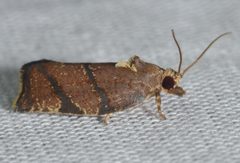
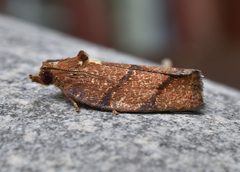
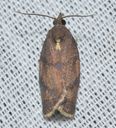
Distinguished from other Argyrotaenia by association with hickory-dominated and confirmed through examination of genitalia. Similar in size and general appearance to A. velutinana (Red-banded Leafroller), but lacks the distinct reddish-brown banding on the forewings characteristic of that species. Dissection or molecular analysis may be required for definitive identification of worn or lightly marked specimens.
Images
Appearance
Small with wingspan of 18–20 mm. Forewings are mottled with variable patterning typical of the , often with silvery or grayish markings. Hindwings are paler and more uniform in color. Resting posture is characteristic of Tortricidae, with wings held roof-like over the body.
Habitat
Deciduous woodlands and parks where hickory (Carya) grows. Occupies forested areas with mature hardwood trees, particularly those containing plants in the walnut (Juglandaceae) and related .
Distribution
Eastern North America: recorded from Alabama, Arkansas, Florida, Illinois, Indiana, Kentucky, Louisiana, Maryland, Mississippi, Missouri, New Hampshire, New York, North Carolina, Ohio, Ontario, Pennsylvania, Quebec, Tennessee, Texas, West Virginia, Wisconsin, and Vermont. Range extends from the Gulf Coast to the Great Lakes region and southern Canada.
Seasonality
on wing from April to August. Single or possibly overlapping , with peak activity in late spring and early summer. Larval stage occurs during the growing season when plant foliage is available.
Diet
Larvae feed on leaves of Corylus (hazelnut), Viburnum (including V. acerifolium), Carya (hickory, including C. cordiformis and C. ovata), Juglans (walnut, including J. nigra), and Prunus . Specific feeding habits of unknown.
Host Associations
- Carya cordiformis - larval bitternut hickory
- Carya ovata - larval shagbark hickory
- Juglans nigra - larval black walnut
- Viburnum acerifolium - larval mapleleaf viburnum
Life Cycle
Complete with , larva, pupa, and stages. Larvae are leafrollers, constructing shelters by folding or rolling leaves of plants. occurs within the larval shelter or in leaf litter. stage not explicitly documented in available sources.
Behavior
Larvae exhibit typical tortricid leaf-rolling , using silk to bind leaves into protective shelters while feeding. are and attracted to artificial light. period spans multiple months, suggesting either extended or partial multivoltinism.
Ecological Role
Herbivore: larval feeding on hardwood tree foliage contributes to nutrient cycling and provides food source for and . Not considered a major pest despite occasional presence in orchards.
Human Relevance
Occasional minor pest in nut orchards and ornamental plantings. No significant economic impact documented. frequently recorded at blacklight stations by citizen scientists and enthusiasts.
Similar Taxa
- Argyrotaenia velutinanaRed-banded Leafroller is similar in size and but distinguished by distinct reddish-brown transverse band on forewings; more and frequently a pest in apple orchards
- Argyrotaenia quercifolianaOak Leafroller Moth overlaps in range and season but associated with oak rather than hickory/walnut ; forewing pattern differs
More Details
Taxonomic history
Originally described as Tortrix juglandana by Fernald in 1879; later transferred to Argyrotaenia. The specific epithet juglandana references the walnut (Juglandaceae), reflecting the primary association.