
Argyrotaenia velutinana
(Walker, 1863)
Red-banded Leafroller Moth, Redbanded Leafroller
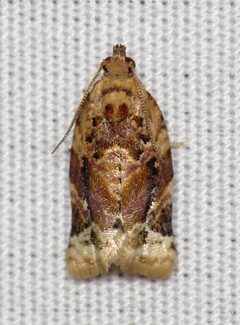
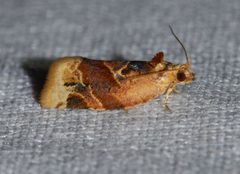
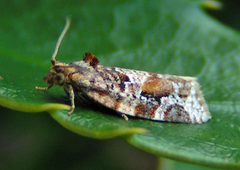
A small tortricid with a wingspan of 13–20 mm, found across eastern North America. The caterpillars are highly , feeding on leaves and fruits of numerous plants including apple and other fruit trees. are frequently attracted to lights and are active across much of the year. The is occasionally a pest in orchards.
Pronunciation
How to pronounce Argyrotaenia velutinana: //ˌɑːr.d͡ʒɪ.roʊˈtiː.ni.ə vɪˌluː.tɪˈnɑː.nə//
These audio files are automatically generated. While they are not always 100% accurate, they are a good starting point.
Identification
Distinguished from other tortricid moths by the characteristic red banding on the forewings, though pattern variability requires caution. The combination of small size (13–20 mm wingspan), eastern North American distribution, and frequent occurrence at lights helps separate it from similar leafroller . Genitalia examination may be necessary for definitive identification where visual features overlap with .
Images
Habitat
Occurs in diverse environments including deciduous forests, orchards, suburban areas, and agricultural landscapes. Associated with areas supporting its broad range of plants.
Distribution
Eastern North America from Quebec and Ontario south to Florida, west to Texas and at least Iowa. Also reported from Saskatchewan, Manitoba, Alberta, and British Columbia. Common east of the Rocky Mountains.
Seasonality
have been observed from early spring through much of the year; exceptionally common at lights over extended periods. Multiple likely occur annually.
Diet
Caterpillars feed on leaves and fruits of numerous plants including apple, other fruit trees, spruce, and various vegetables. Highly with broad range.
Host Associations
- Malus (apple) - larval food plantleaves and fruit
- Picea (spruce) - larval food plant
- Various vegetables - larval food plant
Life Cycle
Complete with , larval, pupal, and stages. Caterpillars feed on plant foliage and fruit, then pupate in a folded leaf on the ground. Neonatal larvae have been observed to commit egg under laboratory conditions, though this is not thought to occur naturally.
Behavior
are and frequently attracted to artificial lights. Males exhibit behavioral responses to disruption in experimental field conditions, with altered movement patterns and mate-finding when exposed to synthetic pheromones. Caterpillars are leafrollers, folding leaves for shelter while feeding.
Ecological Role
Herbivore; caterpillars function as folivores and frugivores. Serves as prey for various and .
Human Relevance
Occasional pest in apple orchards due to fruit and foliage damage by caterpillars. Subject of research on communication disruption for potential management applications.
Similar Taxa
- Other Argyrotaenia speciesSimilar size and general tortricid ; require examination of wing pattern details or genitalia for separation
- Other leafroller moths (Tortricidae)Shared characteristics including leaf-rolling larval ; identification relies on specific wing pattern elements and geographic context
More Details
Research significance
Has been used as a model in studies of communication disruption, contributing to understanding of male behavioral responses in manipulated olfactory environments.