
Archips podana
(Scopoli, 1763)
Large Fruit-tree Tortrix
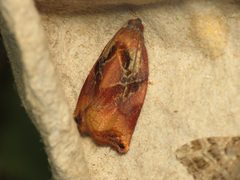
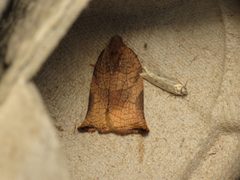
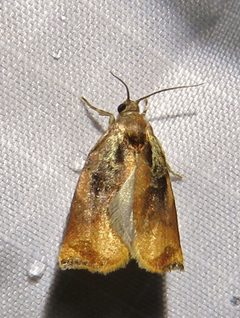
Archips podana is a leafroller in the Tortricidae, first described by Scopoli in 1763. It is notable for exhibiting in male genitalia, with four distinct morphs differing in the presence or absence of and/or lateral prongs on the phallus. The is widely distributed across Europe and Asia, and has been introduced to North America. Larvae are herbivores on deciduous trees and shrubs, with significant economic impact on fruit crops including apple and pear.
Pronunciation
How to pronounce Archips podana: //ˈɑːr.kɪps poʊˈdeɪ.nə//
These audio files are automatically generated. While they are not always 100% accurate, they are a good starting point.
Identification
Distinguished from similar Archips by combination of: crested ; sinuate vertical termen of forewing; short basal costal fold; orange apex of hindwing. Male genitalia show four distinct morphs based on presence/absence of and/or lateral prongs on phallus. Differs from Archips crataegana in distribution (A. crataegana not confirmed in northern Russia). Separated from other leafrollers by wing pattern and male genital .
Images
Habitat
Deciduous trees and shrubs in forest shelterbelts, orchards, and suburban areas. Associated with fruit trees including apple, pear, cherry, plum, and other Rosaceae. Also recorded on conifers. Found in mixed hardwood and conifer forest edges, agricultural landscapes, and urban green spaces with suitable plants.
Distribution
Native to Europe and Asia from Anatolia to Japan. Introduced to North America. In Europe, widely distributed including Belgium and western European countries. Specific study records from central Russia (Lipetsk region, 52°37′N, 39°36′E) at distances 0.5–31 km from industrial centers. Northern distribution limits in Europe require verification; records from Murmansk oblast and Karelia are considered erroneous.
Seasonality
with two periods: early June to early July, and early August to mid-September in western Europe. Single reported May to September in some regions. Adults fly in late afternoon and come to light. Larvae present July to early May; as second instar larvae, resuming development in spring.
Diet
Larvae are herbivores. First instars feed on both leaf surfaces. Later instars feed on leaf undersides within spun webs. Second and third instars feed on fruit surfaces, causing economic damage. Recorded plants include apple (Malus), pear (Pyrus), cherry (Prunus), plum (Prunus), currant (Ribes), lilac (Syringa), and sometimes conifers.
Host Associations
- Malus - larval food plantapple
- Pyrus - larval food plantpear
- Prunus - larval food plantcherry and plum
- Ribes - larval food plantcurrant
- Syringa - larval food plantlilac
- Coniferae - larval food plantsometimes
Life Cycle
. laid in batches of 50–100 on upper leaf surface, covered in wax-like substance; hatch in 17–23 days. Larvae spin fine web, feed on leaf undersides. First : larvae feed on fruit skin, spinning leaf for shelter. Second larvae overwinter in silken on twig in second instar. Spring: fourth instar larvae feed on opening buds, often boring into them, later between spun leaves. occurs in larval shelter.
Behavior
fly in late afternoon and are attracted to light. Larvae exhibit leaf-rolling , spinning silk to bind leaves for shelter. When threatened, larvae may eject from leaf roll using silken line to climb back later. Male genital is heritable; morphs differ in sexual behavior and plant preference. No differential response to industrial pollution among morphs; abundance higher but body size reduced near polluters.
Ecological Role
Herbivore and leafroller on deciduous trees and fruit crops. abundance influenced by and pressure; higher abundance near industrial polluters possibly due to enemy-free space. Serves as prey for solitary including mason wasps (Ancistrocerus unifasciatus) which paralyze caterpillars as food for larvae.
Human Relevance
Significant agricultural pest of fruit crops, particularly apple and pear. Larval feeding on fruit surfaces causes economic damage. Subject of research. Used in studies of industrial pollution effects on insect . Misidentifications in faunistic records have led to erroneous distribution data requiring correction.
Similar Taxa
- Archips crataeganaSimilar appearance and ; distinguished by distribution (A. crataegana not confirmed in northern Russia/Karelia where A. podana records were erroneous)
- Archips purpuranaSimilar leaf-rolling and plants; specific identification requires examination of or male genitalia
- Other Tortricidae leafrollersSimilar larval ; distinguished by wing pattern, male genital , and specific associations
Misconceptions
Historical records from Murmansk oblast and Karelia (Russia) are erroneous; these represent misidentifications. The does not naturally occur that far north; northernmost confirmed records are approximately 1,000 km south of these reported locations.
More Details
Male genital polymorphism
Four distinct morphs identified based on presence/absence of and/or lateral prongs on the phallus. Morphs differ in sexual and plant preference but show similar climatic requirements and to industrial pollution.
Pheromone communication
Uses (E)-11-tetradecenyl acetate and (Z)-11-tetradecenyl acetate for sexual communication.
Response to pollution
1992 study found no correlation between industrial pollution gradient and phenotypic diversity; all four male morphs showed similar . Higher abundance but smaller body size observed near polluters, possibly due to reduced / pressure.
Sources and further reading
- BugGuide
- Wikipedia
- GBIF taxonomy match
- iNaturalist taxon
- Catalogue of Life
- Pensoft Editorial Team | Blog - Part 69
- Bug Eric: How to Catch a Leafroller Caterpillar (Video)
- Fecundity of large fruit-tree tortrix Archips podana Scop. (Lepidoptera: Tortricidae) on different host plants
- Phenotypic Diversity of a Leafroller Archips podana (Lepidoptera, Tortricidae) Does Not Change along an Industrial Pollution Gradient.