
Cydia piperana
Kearfott, 1907
Ponderosa Pine Seedworm Moth
Cydia piperana, commonly known as the ponderosa pine seedworm , is a small tortricid moth native to southwestern North America. The is specialized on conifer , with larvae developing within the seeds of Pinus ponderosa and Pinus jeffreyi. are modest in size with a wingspan of approximately 19 mm. The moth is of ecological interest as a seed in pine and has potential relevance to forest health monitoring, though it is not considered a major economic pest.
Pronunciation
How to pronounce Cydia piperana: //ˈsɪdiə paɪˈpɛrænə//
These audio files are automatically generated. While they are not always 100% accurate, they are a good starting point.
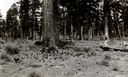
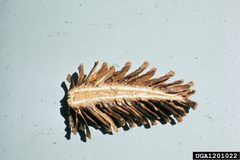
Images
Appearance
have a wingspan of approximately 19 mm. As a member of the Tortricidae , adults likely exhibit the characteristic bell-shaped wing posture at rest typical of tortricid moths. Specific coloration and pattern details are not well documented in available sources.
Distribution
Southwestern North America.
Diet
Larvae feed on the seeds of Pinus ponderosa (ponderosa pine) and Pinus jeffreyi (Jeffrey pine).
Host Associations
- Pinus ponderosa - larval larvae feed on seeds
- Pinus jeffreyi - larval larvae feed on seeds
Ecological Role
Seed in pine ; larvae consume developing seeds within pine cones, potentially affecting seed production and natural of trees.
Similar Taxa
- Cydia latiferreanaBoth are conifer-feeding Cydia in western North America; C. latiferreana (filbertworm) feeds on oak acorns and pine nuts rather than pine seeds, and has a broader range including hardwoods.
- Cydia pomonellaBoth belong to Cydia and share similar , but C. pomonella is a major pest of apple and pear orchards worldwide with different associations and economic significance.
Sources and further reading
- BugGuide
- Wikipedia
- GBIF taxonomy match
- iNaturalist taxon
- NCBI Taxonomy
- Catalogue of Life
- Blacklighting at the Bohart: They Saw the Light | Bug Squad
- What Will You See at Bohart Museum Open House | Bug Squad
- Like a Moth to a Flame: Moth Night at Bohart Museum of Entomology | Bug Squad
- Oh, What a (Moth) Night! | Bug Squad
- Line Trapping: A Promising Method for More Accurate Pest Monitoring
- Odorant Receptor Gene in Codling Moth Also Affects Egg Production