
Proteoteras
Riley, 1881
boxelder twig borer moth, maple twig borer moth
Species Guides
7- Proteoteras aesculana(maple twig borer)
- Proteoteras arizonae
- Proteoteras crescentana(Black-crescent Proteoteras Moth)
- Proteoteras moffatiana(gray-flanked proteotera)
- Proteoteras naracana
- Proteoteras obnigrana
- Proteoteras willingana(eastern boxelder twig borer moth)
Proteoteras is a of tortricid moths in the Olethreutinae, commonly known as . The genus includes at least eight described , several of which are economically significant pests of maple and boxelder trees. Larvae tunnel in twigs, petioles, and seeds, causing terminal dieback and structural damage. The genus was established by Riley in 1881, with P. aesculana as the type species.


Pronunciation
How to pronounce Proteoteras: //ˌproʊtiˈoʊtərəs//
These audio files are automatically generated. While they are not always 100% accurate, they are a good starting point.
Identification
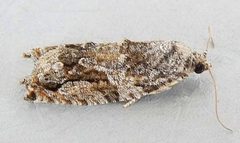
Proteoteras are small tortricid moths that can be distinguished from other Olethreutinae by their association with Aceraceae and larval boring habits. Specific species identification requires examination of genitalia or rearing from confirmed host material. P. aesculana (maple shoot borer) and P. willingana (boxelder ) are the most commonly encountered species in North America.
Images
Habitat
Deciduous forests and urban plantings where trees occur; production nurseries where maple trees are grown commercially.
Distribution
North America. Specific distribution varies by : P. aesculana occurs in eastern North America with records from Kentucky and Kansas; P. willingana was described from Saskatchewan, Canada; other species have more restricted western ranges (P. arizonae, P. naracana).
Seasonality
fly in spring, with beginning as early as March and peaking in early spring. P. aesculana shows bimodal adult activity with a second peak in late May and June; sporadic captures may occur into November, suggesting possible adult .
Diet
Larvae feed internally in twigs, petioles, and seeds of trees. P. aesculana larvae tunnel in terminal shoots of maple (Acer spp.), causing tip dieback. P. willingana larvae feed in boxelder twigs.
Host Associations
- Acer spp. - larval maple; primary for P. aesculana
- Acer negundo - larval boxelder; for P. willingana
Life Cycle
. emerge in spring and lay on or near buds. Larvae bore into shoots and develop during April and May, causing terminal damage. Larvae construct silken for . occurs in spring.
Behavior
are attracted to light. Larvae are internal feeders that tunnel in young shoots, causing characteristic dieback and forking of terminal growth. Larvae construct silken at the base of plants for .
Ecological Role
Primary consumer of maple tissues; acts as a pest in nursery production systems. Three have been documented attacking P. aesculana, though their impact on is unknown.
Human Relevance
Economic pest of maple trees in production nurseries. P. aesculana causes significant damage through terminal shoot boring, reducing tree quality and requiring intervention. Bifenthrin applications timed to can reduce by 96–100%.
Similar Taxa
- Episimus tyriusAnother tortricid causing leaf-tying damage on maple in late summer; distinguished by feeding habit (leaf-tying vs. shoot boring) and seasonal timing
More Details
Pheromone biology
P. aesculana uses (Z)-dodec-8-en-1-ol (Z8-12:OH) as the major component, which has been used to develop monitoring lures for nursery management.
Species diversity
The contains eight described : P. aesculana, P. arizonae, P. crescentana, P. implicata, P. moffatiana, P. naracana, P. obnigrana, and P. willingana.
Sources and further reading
- BugGuide
- Wikipedia
- GBIF taxonomy match
- iNaturalist taxon
- NCBI Taxonomy
- Catalogue of Life
- Bug Eric: First Night of Blacklighting
- Bug Eric: April 2024
- The Boxelder Twig Borer, Proteoteras willingana (Kearfott), (Lepidoptera: Olethreutidae)
- Seasonal biology and management of the maple shoot borer, Proteoteras aesculana (Lepidoptera: Tortricidae), in production nurseries