
Proteoteras aesculana
Riley, 1881
maple twig borer, maple tip moth, early proteoteras, Maple Twig Borer Moth
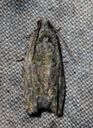
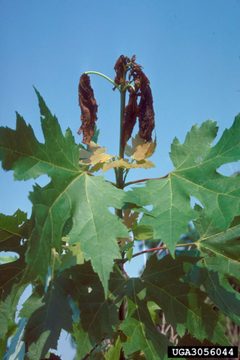
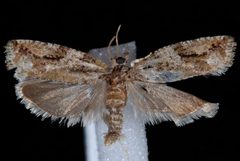
Proteoteras aesculana is a small tortricid known as the maple or maple tip moth. It is a significant pest of maple trees in production nurseries, where larval feeding causes tip dieback and kills the central leader. The has a broad North American distribution spanning from coast to coast in the northern United States and scattered locations across southern Canada.
Pronunciation
How to pronounce Proteoteras aesculana: /proʊˈtiː.oʊˌtɛ.rəs iːˌskjuːˈlæ.nə/
These audio files are automatically generated. While they are not always 100% accurate, they are a good starting point.
Identification
Wingspan 11–18 mm. Specific diagnostic features for field identification are not documented in available sources. As a small tortricid , it likely exhibits the characteristic bell-shaped resting posture with wings folded roof-like over the body, but -level identification requires examination of genitalia or specialized knowledge of tortricid .
Images
Habitat
Occurs in environments where maple trees (Acer spp.) are present, including production nurseries, natural forests, and urban plantings. The is tightly associated with its tree throughout its .
Distribution
Coast to coast in the northern United States, south to Mississippi in the east and California in the west. Scattered distribution in Canada from Nova Scotia to southern Alberta, with records from Alberta, Manitoba, and Saskatchewan.
Seasonality
begins in March, peaking in early spring. A second of is active in late May and June. Sporadic captures occur into November, suggesting that adults may overwinter.
Host Associations
- Acer - primary maple trees; larvae tunnel in twigs, petioles, and seeds
- Acer - oviposition site laid in early spring on maple trees in nursery settings
Life Cycle
Complete . Larvae develop during April and May, feeding within maple twigs and shoots. occurs within the plant. emerge in late May and June for the second period. No additional larvae are found in maples following the June flight, suggesting a or partially pattern with possible adult .
Behavior
Larvae are internal feeders that tunnel in maple twigs, petioles, and seeds, causing characteristic tip dieback. are and attracted to blacklight. Males are attracted to synthetic lures containing (Z)-dodec-8-en-1-ol.
Ecological Role
Pest in maple production systems. Three species have been documented attacking this , all representing new records.
Human Relevance
Economic pest in maple tree nurseries, causing damage that kills the central leader and reduces tree quality. Management relies on timed applications; a single bifenthrin spray applied from just before bud break through peak reduces by 96–100%. Synthetic lures are used for monitoring and timing control measures.
Similar Taxa
- Episimus tyriusAnother tortricid associated with maples, but causes leaf-tying damage in late summer rather than shoot boring in spring
- Other Proteoteras speciesCongeneric may overlap in range and require genitalia examination for definitive identification