
Samea multiplicalis
(Guenée, 1854)
salvinia stem-borer moth
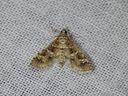
Samea multiplicalis is an aquatic native to the Americas, ranging from the southern United States to Argentina, and introduced to Australia in 1981 as a agent for water ferns. are small, tan moths with darker wing markings and a wingspan of approximately 20 mm. The completes its entire on or near aquatic plants, with larvae feeding internally on stems and externally on leaves, often causing plant death. High rates of by native and flies limit its effectiveness as a weed control agent in introduced ranges.
Pronunciation
How to pronounce Samea multiplicalis: //ˈsæmiə ˌmʌltɪpɪˈkeɪlɪs//
These audio files are automatically generated. While they are not always 100% accurate, they are a good starting point.
Identification
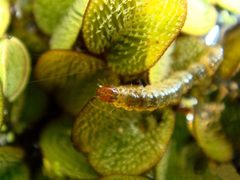
can be recognized by their small size, tan ground color, and darker wing patterning. Aquatic association and presence on floating water plants (Salvinia, Pistia, Azolla) are strong indicators. Larvae are pale yellow to green, found boring into stems or feeding under silk on leaves of aquatic plants. Distinguished from similar aquatic pyralids by plant association and geographic range; in Australia, co-occurs with the salvinia weevil Cyrtobagous salviniae but differs in being a rather than , with faster and but lower field effectiveness due to .
Images
Habitat
Freshwater aquatic environments including ponds, lakes, and slow-moving rivers. Associated with floating mats of aquatic vegetation on calm or still water surfaces. Requires warm conditions; survives in temperature range of 11–36 °C with optimal development around 30 °C. can persist year-round where food and temperature remain adequate.
Distribution
Native to the Americas: southeastern United States (west to Louisiana) through Central and South America to Argentina; first described from Brazil in 1854. Introduced to Australia in 1981, now established in Queensland and New South Wales. Records also exist from Botswana, South Africa, and Zambia (GBIF).
Seasonality
Active year-round in suitable warm ; persist through winter where food resources and temperatures remain adequate. Oviposition occurs during scotophase (dark period), concentrated in the first 2 hours.
Diet
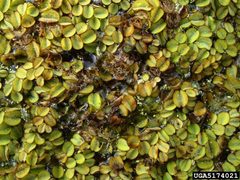
Larvae feed on aquatic plants: primarily Pistia stratiotes (water lettuce), Salvinia molesta (giant salvinia), Salvinia rotundifolia, Azolla caroliniana (water velvet), and occasionally Eichhornia crassipes (water hyacinth). Larvae bore into stems or feed externally on leaves. do not feed; they mate and oviposit on plants.
Host Associations
- Pistia stratiotes - primary Preferred for oviposition and feeding in native range; rosette structure provides abundant oviposition surfaces
- Salvinia molesta - Primary in introduced Australian range; water fern targeted for
- Salvinia rotundifolia - Native range
- Azolla caroliniana - Water velvet
- Eichhornia crassipes - occasional Water hyacinth; not preferred for oviposition
Life Cycle
hatch in approximately 4 days. Larvae develop through 5 instars over about 2 weeks (6 instars and additional 2–3 days under low-nitrogen conditions); male larvae develop faster than females by about 2 days. occurs within silk cocoons constructed inside leaf petioles, lasting 4–10 days with females developing faster than males. lifespan is 3–4 weeks. Total time from egg to adult death is typically 3–4 weeks.
Behavior
Larvae exhibit cooperative : groups construct silk over feeding sites for protection from , expanding the canopy as they move to new areas. Females show strong oviposition selectivity, preferring plants with high nitrogen content and undamaged plants over previously damaged ones; also prefer sun-grown over shade-grown plants when nitrogen is low. Oviposition is , concentrated in the first 2 hours of scotophase. Larvae show compensatory feeding: when nitrogen is low, they increase consumption rate and volume to compensate for nutrient dilution, though this does not fully mitigate poor food quality.
Ecological Role
Herbivore of aquatic plants; in native range, contributes to natural control of floating vegetation. In introduced range (Australia), intended as agent for Salvinia molesta, though effectiveness limited by . Serves as for native (braconid wasps, tachinid flies) and () in both native and introduced ranges.
Human Relevance
Introduced to Australia in 1981 as agent for Salvinia molesta, an water fern that forms dense mats crowding native vegetation and reducing light penetration. Less effective than the co-introduced weevil Cyrtobagous salviniae due to high rates (approximately 22% larval parasitism in Queensland, with 90% of mortality from a single braconid , Protomicroplitis sp.). Still used as component of integrated weed management.
Similar Taxa
- Cyrtobagous salviniaeCo-occurring agent for Salvinia molesta; both share , plants, nitrogen requirements, and optimal temperature of 30 °C. S. multiplicalis has higher reproductive rate and ability but lower field effectiveness due to ; C. salviniae is a (Curculionidae) rather than .
- Spodoptera pectinicornisSimilar lepidopteran agent for Pistia stratiotes; both show compensatory feeding responses to low plant nitrogen, though S. multiplicalis is already widely established.
More Details
Nitrogen requirements
Larval nitrogen intake is critical in first two instars; insufficient nitrogen leads to reduced digestive throughout life and decreased production in females. Larvae on high-nitrogen plants show 40% greater final and faster development compared to low-nitrogen conditions.
Feeding rate
S. multiplicalis larvae feed at rates 5–10 times greater than comparable lepidopteran , likely reflecting to high-water-content plants and functioning near physiological limits for ingestion.
Parasitism impact
rates remain steady through spring, summer, and fall, decreasing slightly in winter. This consistent pressure prevents growth and necessary for effective weed control, explaining why S. multiplicalis has not matched the success of C. salviniae despite superior reproductive potential.
Sources and further reading
- BugGuide
- Wikipedia
- GBIF taxonomy match
- iNaturalist taxon
- NCBI Taxonomy
- Catalogue of Life
- NATIVE PARASITOIDS AND PATHOGENS ATTACKING SAMEA MULTIPLICALIS GUENÉE (LEPIDOPTERA: PYRALIDAE) IN QUEENSLAND
- Oviposition preferences of the salvinia moth Samea multiplicalis Guenée (Lep., Pyralidae) in relation to hostplant quality and damage
- Compensatory responses of Samea multiplicalis larvae when fed leaves of different fertilization levels of the aquatic weed Pistia stratiotes
- Variation in the life history of the Salvinia moth Samea multiplicalis guenee (Lepidoptera, Pyralidae) in response to temperature and host plant nitrogen
- Impact and interaction of Samea multiplicalis (Lepidoptera: Pyralidae) and Cyrtobagous salviniae (Coleoptera: Curculionidae) on Salvinia minima in south Louisiana and the foraging behavior of Solenopsis invicta (Hymenoptera: Formicidae) on Salvinia minima
- Life History and Biology of Samea multiplicalis1 , 2