
Cyrtobagous
Hustache, 1929
salvinia weevil
Species Guides
1- Cyrtobagous salviniae(salvinia weevil)
Cyrtobagous is a of small weevils in the Curculionidae, native to South America. The genus contains specialized as agents for aquatic ferns in the genus Salvinia. C. salviniae has been introduced to multiple continents to manage giant salvinia (Salvinia molesta), while C. singularis has more limited effectiveness. Both species complete their within or on their plants in aquatic environments.
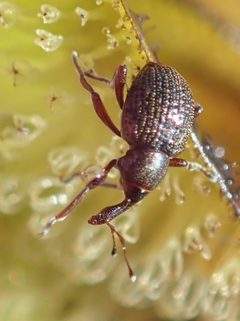
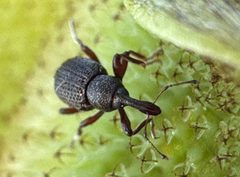
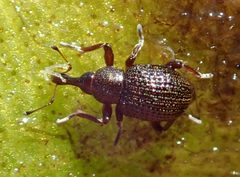
Pronunciation
How to pronounce Cyrtobagous: //ˌsɜːrtoʊˈbæɡəs//
These audio files are automatically generated. While they are not always 100% accurate, they are a good starting point.
Images
Habitat
Freshwater aquatic systems; associated with floating aquatic ferns of the Salvinia. Larvae develop within submerged rhizomes and require high humidity. are subaquatic or semi-aquatic, feeding on buds and leaves at or below the water surface.
Distribution
Native to South America (Brazil, Paraguay, Uruguay, Argentina); introduced to Australia, Africa, southeastern United States (Texas, Louisiana, Florida, South Carolina), Hawaii, Puerto Rico, and parts of Asia. GBIF records indicate presence in Amazonas, Bolívar (Venezuela), and Chocó (Colombia).
Diet
Specialized herbivores feeding on Salvinia . Larvae tunnel through and consume rhizomes, with first and third instars preferring young rhizomes and second instars feeding on mature rhizomes. feed on buds, young leaves, and rhizomes.
Host Associations
- Salvinia molesta - primary main target for ; supports complete larval development
- Salvinia minima - supports development; used for control in Florida
- Salvinia auriculata - native in Brazil; documented as
Life Cycle
to development takes approximately 40 days at 27°C. Females lay eggs individually in lower leaves and rhizomes; larvae pass through three instars, pupate underwater within rhizomes in cocoons woven from root hairs, and emerge as adults. Larval development requires tunneling into rhizomes and fails to complete if restricted to root browsing alone.
Behavior
Larvae are negatively phototactic, avoiding light. Both larvae and are highly sensitive to desiccation and require high humidity. Adults disperse among water bodies via floating mats of their plant. Female oviposition shifts based on plant condition: laid in buds of undamaged plants with thin rhizomes, but in thicker rhizomes of damaged plants where larval development occurs. Oviposition rate depends on bud availability and nitrogen content.
Ecological Role
agent for aquatic weeds. Feeding by larvae and kills plants, reducing plant by 90% or more within a year in successful introductions. This restores navigation, water quality, recreational use, and irrigation functions in infested waterways. In its native range, regulates Salvinia .
Human Relevance
Widely used in programs against giant salvinia (Salvinia molesta), one of the world's worst aquatic weeds. Successfully established in over 20 countries. Effectiveness varies with latitude and temperature, with reduced performance above 31°18'N. Subject to pressure from sp. in some introduced , which reduces reproductive output and control efficacy. Not a pest of crops or native vegetation.
Similar Taxa
- Cyrtobagous singularisClosely related congeneric with overlapping native range and use. C. singularis is generally ineffective as a substitute for C. salviniae in due to slightly different ; both species were historically confused prior to formal description of C. salviniae in 1985.
More Details
Disease and Management
of C. salviniae in South Africa are extensively infected (92-100%) by the parasitic sp., which reduces reproductive output and weed control efficacy. load is temperature-dependent, with lowest loads at 30°C and highest at 14°C. Ketoconazole treatment can reduce in laboratory-reared populations but is impractical for field application.
Salinity Tolerance
While Salvinia molesta growth declines at 5 ppt salinity and fails at 10 ppt, C. salviniae feeding shows no significant difference across salinity levels in controlled settings. However, field decrease at higher salinities, suggesting is less effective in coastal or saline-influenced environments.
Sources and further reading
- BugGuide
- Wikipedia
- GBIF taxonomy match
- iNaturalist taxon
- NCBI Taxonomy
- Catalogue of Life
- Salvinia weevil, Cyrtobagous salviniae (Calder & Sands) (Insecta: Coleoptera: Curculionidae)
- A NEW BRAZILIANCYRTOBAGOUSHUSTACHE (COLEOPTERA: CURCULIONIDAE) INTRODUCED INTO AUSTRALIA TO CONTROL SALVINIA
- THE FEEDING CHARACTERISTICS AND DEVELOPMENT OF LARVAE OF A SALVINIA WEEVIL CYRTOBAGOUS SP
- Effect of Helicosporidium sp. (Chlorophyta; Trebouxiophyceae) infection on Cyrtobagous salviniae Calder and Sands (Coleoptera: Curculionidae), a biological control agent for the invasive Salvinia molesta D.S. Mitchell (Salviniaceae) in South
- Impact and interaction of Samea multiplicalis (Lepidoptera: Pyralidae) and Cyrtobagous salviniae (Coleoptera: Curculionidae) on Salvinia minima in south Louisiana and the foraging behavior of Solenopsis invicta (Hymenoptera: Formicidae) on Salvinia minima
- Impact of the fungal pathogen, SPFG, on the Salvinia molesta Mitchell biological control agent, Cyrtobagous salviniae (Coleoptera: Curculionidae)
- Performance of Salvinia molesta (Salviniae: Salviniaceae) and its biological control agent Cyrtobagous salviniae (Coleoptera: Curculionidae) in freshwater and saline environments
- Preliminary studies on changes in distribution of aquatic macrophytes in the Lunuwila tank in 1991-1993, after introduction of Cyrtobagous salviniae to control Salvinia molesta
- New record of Cyrtobagous salviniae Calder & Sands, 1985 (Coleoptera: Curculionidae) from southeastern Brazil with comments on its dispersal among freshwater ponds
- Oviposition by the weevil Cyrtobagous salviniae Calder and Sands when its host plant, Salvinia molesta is damaged
- Distribution, biology and host specificity ofCyrtobagous singularisHustache (Coleoptera: Curculionidae) for the biological control ofSalvinia molesta