
Cyrtobagous salviniae
Calder & Sands, 1985
salvinia weevil, Kariba Weed Biocontrol Weevil
Cyrtobagous salviniae is a subaquatic weevil native to Brazil, widely distributed as a agent for aquatic ferns of the Salvinia. It has proven effective in reducing of Salvinia molesta and Salvinia minima in tropical and subtropical regions, with documented reductions exceeding 90% in under one year in some cases. The is subject to natural enemy pressure from such as sp., which can reduce its reproductive output and efficacy.
Pronunciation
How to pronounce Cyrtobagous salviniae: //sɪrˌtoʊˈbæɡəs sælˈvɪni.aɪ//
These audio files are automatically generated. While they are not always 100% accurate, they are a good starting point.
Identification
Distinguished from the closely related Cyrtobagous singularis by ecological and behavioral differences: C. salviniae exhibits continuous oviposition ( laid in 92% of weeks) versus intermittent oviposition in C. singularis (50% of weeks with 2-week average intervals), and produces approximately seven times more eggs at comparable temperatures. C. salviniae also shows higher intrinsic rates of increase across temperatures (23°C, 27°C, 31°C) and is less affected by nitrogen concentration in plants.
Images
Appearance
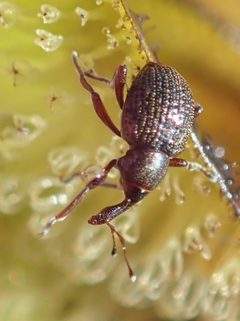
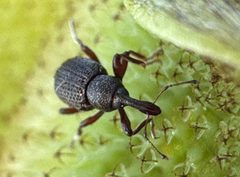
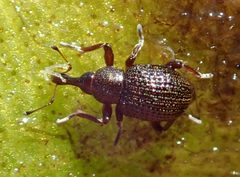
are approximately 2 mm long. Newly emerged adults are brown in color, turning shiny black within a few days. Larvae are white, approximately 4 mm long, and develop within plant rhizomes.
Habitat
Subaquatic freshwater environments, particularly those supporting Salvinia . Tolerates salinity up to 10 ppt in controlled settings, though field show reduced at higher salinities. Disperses among freshwater ponds via floating mats of plants displaced during floods.
Distribution
Native to southeastern Brazil, with documented native in Minas Gerais and other southeastern states. Introduced to multiple countries for , including the United States (established in Florida, Texas, Louisiana, and other southeastern states), South Africa (released 1985), Australia, and parts of Africa and Southeast Asia.
Diet
herbivore feeding on aquatic ferns Salvinia molesta and Salvinia minima. feed on buds and leaves; larvae feed voraciously on new buds and rhizome tissue, causing greater damage than adults.
Host Associations
- Salvinia molesta - primary main target for ; feeding kills plant
- Salvinia minima - also fed upon; controlled in Florida
- Salvinia auriculata - substratemats used for among ponds
Life Cycle
are laid individually in lower leaves and rhizomes of plants, with females producing over 300 eggs. Larvae burrow through rhizomes and feed on new buds. occurs underwater within a cocoon woven from root hairs among the rhizomes. Developmental rates and oviposition are temperature-dependent, with optimal performance at 30°C.
Behavior
Oviposition varies with plant condition: on undamaged plants with thin rhizomes, are laid primarily in buds; on damaged plants with thicker rhizomes, eggs are laid predominantly in rhizomes where larval development occurs. Females reduce oviposition on plants previously damaged by conspecifics or by the Samea multiplicalis, with oviposition rate dependent on bud availability and nitrogen content. Oviposition is nearly continuous under favorable conditions.
Ecological Role
agent that kills Salvinia through larval and feeding, restoring recreational, agricultural, and functions in aquatic systems. Can reduce plant by 90% or more within one year. Subject to pressure from sp., which can reduce reproductive output and biocontrol efficacy.
Human Relevance
Widely used intentional agent for managing aquatic weeds. Has successfully controlled Salvinia molesta and S. minima in multiple countries, clearing waterways and restoring water body functionality. Health status monitoring recommended for biocontrol programs due to vulnerability to .
Similar Taxa
- Cyrtobagous singularisClosely related congeneric with similar but distinct ; C. singularis from Trinidad has lower , intermittent oviposition, and is generally ineffective as a substitute biocontrol agent for C. salviniae
More Details
Disease vulnerability
Subject to by the parasitic sp., which occurs at 92-100% in some South African . Infection reduces reproductive output and reduction impact on plants. load is temperature-dependent, with lowest loads at 30°C and highest at 14°C. Ketoconazole treatment can reduce infection loads in rearing facilities but is not field-applicable.
Temperature optima
Optimal performance occurs at approximately 30°C; at 31°C, oviposition is reduced by approximately 45% with reduced hatch. Limited effectiveness has been observed in northern extremes of its distribution (above 31°18'0"N), though this varies with local weather patterns.
Sources and further reading
- BugGuide
- Wikipedia
- GBIF taxonomy match
- iNaturalist taxon
- NCBI Taxonomy
- Salvinia weevil, Cyrtobagous salviniae (Calder & Sands) (Insecta: Coleoptera: Curculionidae)
- Performance of Salvinia molesta (Salviniae: Salviniaceae) and its biological control agent Cyrtobagous salviniae (Coleoptera: Curculionidae) in freshwater and saline environments
- Impact of the fungal pathogen, SPFG, on the Salvinia molesta Mitchell biological control agent, Cyrtobagous salviniae (Coleoptera: Curculionidae)
- Effect of Helicosporidium sp. (Chlorophyta; Trebouxiophyceae) infection on Cyrtobagous salviniae Calder and Sands (Coleoptera: Curculionidae), a biological control agent for the invasive Salvinia molesta D.S. Mitchell (Salviniaceae) in South
- Impact and interaction of Samea multiplicalis (Lepidoptera: Pyralidae) and Cyrtobagous salviniae (Coleoptera: Curculionidae) on Salvinia minima in south Louisiana and the foraging behavior of Solenopsis invicta (Hymenoptera: Formicidae) on Salvinia minima
- Preliminary studies on changes in distribution of aquatic macrophytes in the Lunuwila tank in 1991-1993, after introduction of Cyrtobagous salviniae to control Salvinia molesta
- New record of Cyrtobagous salviniae Calder & Sands, 1985 (Coleoptera: Curculionidae) from southeastern Brazil with comments on its dispersal among freshwater ponds
- Oviposition by the weevil Cyrtobagous salviniae Calder and Sands when its host plant, Salvinia molesta is damaged
- A comparative study on the intrinsic rates of increase of Cyrtobagous singularis and C. salviniae on the water weed Salvinia molesta