
Phoebis
Hübner, 1819
sulphurs, sulfurs
Species Guides
4- Phoebis agarithe(Large Orange Sulphur)
- Phoebis neocypris(Tailed Sulphur)
- Phoebis philea(Orange-barred Sulphur)
- Phoebis sennae(Cloudless Sulphur)
Phoebis, commonly known as sulphurs, is a of butterflies in the Pieridae, Coliadinae. The genus is native to the Americas, with distributed from the southern United States through Central and South America. Members are characterized by bright yellow, orange, or white coloration. Several species are known for seasonal patterns, particularly northward movements in spring and southward returns in fall. The genus includes economically and ecologically significant species such as the cloudless sulphur (Phoebis sennae), which has been extensively studied for its and plant associations.
Pronunciation
How to pronounce Phoebis: /ˈfiːbɪs/
These audio files are automatically generated. While they are not always 100% accurate, they are a good starting point.
Identification
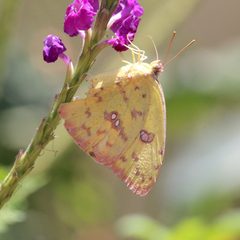
Phoebis are distinguished from other Coliadinae by their larger size, more robust body, and generally brighter, less heavily spotted wing patterns compared to Colias and Gonepteryx. Within the genus, species can be separated by specific wing markings: P. sennae (cloudless sulphur) has minimal wing markings with unmarked bright yellow wings in males; P. philea (orange-barred sulphur) shows distinct orange transverse bars on forewings; P. agarithe (large orange sulphur) is larger with more extensive orange coloration; P. argante (apricot sulphur) has pale orange to yellow wings with variable dark markings. P. neocypris (tailed sulphur) has noticeable tail-like projections on the hindwings. is rapid and direct, often with gliding periods, differing from the more fluttering flight of smaller sulphurs.
Images
Habitat
Occurs in diverse open including tropical and subtropical forests, forest edges, savannas, grasslands, agricultural areas, and gardens. -specific habitat preferences vary: P. sennae is common in open, disturbed areas and agricultural lands where plants grow; P. argante inhabits dry forest in the western Andes. Many species are associated with leguminous host plants, limiting distribution to areas where these plants occur. Elevation ranges from sea level to montane regions depending on species.
Distribution
Native to the Americas. Range extends from the southern United States (southern Texas, Florida, and occasionally northward during ) through Mexico, Central America, and South America to Peru, Brazil, and Argentina. Individual distributions vary: P. sennae occurs from southern North America through South America; P. agarithe ranges from southern US to Peru; P. argante is found from Mexico to Peru and Brazil, including the Caribbean; P. philea occurs from Mexico to Peru, Brazil, Cuba, and Hispaniola; P. neocypris ranges from Mexico to Peru and Brazil; P. editha is restricted to Haiti; P. avellaneda is to Cuba.
Seasonality
are active year-round in tropical portions of the range. In temperate regions, activity is seasonal with spring and fall . The cloudless sulphur (P. sennae) migrates northward in spring and summer, reaching as far north as Canada in some years, then returns southward in fall. Peak abundance in the southern United States occurs late summer through fall. Some show fluctuations tied to seasonal availability of plants.
Diet
feed on nectar from a variety of flowers, with documented preference for composite flowers (Asteraceae) including thistles (Cirsium), asters, and goldenrods. They have also been observed feeding at sap flows on trees. Larvae are feeders on leguminous plants (Fabaceae), particularly in the Senna, Inga, and related .
Host Associations
- Senna occidentalis - larval Primary for Phoebis sennae; documented in Florida and southern US
- Inga edulis - larval plant for Phoebis argante in Ecuador; leguminous tree with cultural and ecological significance in Neotropics
- Senna - larval -level association for multiple Phoebis
Life Cycle
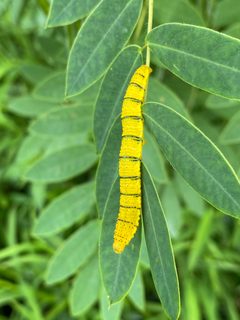
Complete with four stages: , larva, pupa, and . Eggs are laid singly on plant leaves. Larvae are green with longitudinal stripes, cylindrical, and relatively smooth. Development time from oviposition to adult averages approximately 48 days in P. argante, though this likely varies by and temperature. Pupae are attached to host plants or nearby vegetation by silk girdle and . in pupal coloration has been documented: female P. argante pupae show heterogeneous patterns with black spots, while males are uniformly yellowish-green. Adults emerge and may live several weeks to months depending on season and .
Behavior
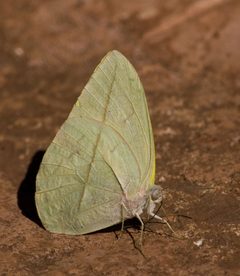
Strong, rapid, direct with periods of gliding. Males patrol for females and engage in rapid courtship flights. Seasonal is well-documented in P. sennae, with individuals traveling hundreds of kilometers northward in spring and returning south in fall. Fall migrants orient south-southwest and may navigate using visual cues. often congregate at mud puddles and moist soil to obtain minerals. Males are territorial around plants and nectar sources. Roosting occurs with wings closed, often on vegetation that provides camouflage for the pale underside.
Ecological Role
serve as for diverse flowering plants, particularly composites. Larvae function as herbivores on leguminous plants, with limited impact due to their relatively low densities. The facultative mutualism between P. sennae larvae and imported fire ants (Solenopsis invicta) on Senna occidentalis has been documented: ants protect larvae from and in exchange for sugary secretions. plants such as Inga edulis provide for pollinating insects and contribute to soil erosion prevention, suggesting potential for revegetation projects.
Human Relevance
Popular subjects for watching and photography due to bright coloration and approachable . Cloudless sulphurs are common in butterfly gardens and educational exhibits. Some serve as indicators of quality and climate change effects due to their migratory behavior and sensitivity to plant availability. The has been studied for evolutionary of coloration, , and host plant specialization. No significant agricultural pest status, though larvae feed on some ornamental legumes.
Similar Taxa
- ColiasSimilar 'sulphurs' and yellow/orange coloration, but Colias are generally smaller, have more rounded wings, more extensive dark spotting, and inhabit primarily Holarctic regions including North American prairies and alpine meadows.
- AphrissaFormerly included some Phoebis (e.g., P. orbis moved to Aphrissa orbis); Aphrissa species are generally smaller with more delicate build and different wing venation.
- GonepteryxPale yellow or white coloration similar to some Phoebis, but Gonepteryx is restricted to the Old World and has more angular wing shapes with distinctive wing tips.
- EuremaSmall yellow butterflies in the same , but much smaller size (wingspan 25–35 mm), more fluttering , and different wing shape with more rounded margins distinguish them from Phoebis.
More Details
Taxonomic history
The has undergone taxonomic revision, with some formerly placed in Phoebis now assigned to Aphrissa (e.g., Phoebis orbis moved to Aphrissa orbis). The genus name Phoebis is derived from Greek mythology.
Research significance
Phoebis sennae has been extensively studied as a model organism for , orientation , and physiological adaptations for long-distance . Studies have examined magnetic field sensitivity, visual navigation cues, and energy metabolism during migration.
Conservation notes
Most are widespread and not of conservation concern, though loss and use affect local . The migratory of P. sennae makes populations vulnerable to habitat fragmentation across large geographic .
Sources and further reading
- BugGuide
- Wikipedia
- GBIF taxonomy match
- iNaturalist taxon
- NCBI Taxonomy
- Catalogue of Life
- A new population of the federally-endangered decurrent false aster | Beetles In The Bush
- Bug Eric: Grand Finale
- Plantae | Beetles In The Bush | Page 7
- Insecta | Beetles In The Bush | Page 8
- Cloudless Sulphur Phoebis sennae (Linnaeus) (Insecta: Lepidoptera: Pieridae: Coliadinae)
- Life history of the butterfly Phoebis argante (Fabricius, 1775) (Lepidoptera: Pieridae), an inhabitant of the dry forest of western Andes