
Phoebis philea
(Linnaeus, 1763)
Orange-barred Sulphur
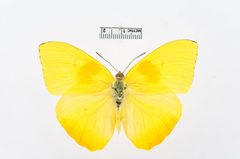
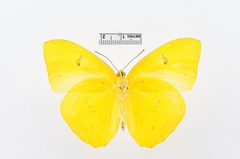
Phoebis philea, the orange-barred sulphur, is a medium-sized in the Pieridae found throughout the Americas from the southern United States to Brazil, including the Caribbean. are known for their bright yellow-orange coloration with distinctive orange bars on the forewings. The exhibits seasonal variation in number, with multiple in southern regions and a single generation in northern parts of its range. Larvae feed on Cassia species, while adults visit nectar sources, particularly red-colored flowers.

Pronunciation
How to pronounce Phoebis philea: //ˈfiːbɪs ˈfaɪliə//
These audio files are automatically generated. While they are not always 100% accurate, they are a good starting point.
Identification
Distinguished from other Phoebis by the orange bars on the forewings (absent in P. sennae, the cloudless sulphur). Smaller and more brightly marked than Aphrissa statira (statira sulphur) and Phoebis argante (apricot sulphur), with which it often congregates. The orange bars separate it from the straight-line sulphur (Rhabdodryas trite).
Images
Habitat
Tropical scrub, gardens, agricultural fields, and forest edges. Occupies open, sunny with nectar sources and larval plants. Tolerates disturbed and anthropogenic environments including urban gardens.
Distribution
Widespread in the Americas from the southern United States (Florida) through Mexico, Central America, and South America to Brazil. Occurs throughout the Caribbean, with P. p. huebneri on Cuba and P. p. thalestris on Hispaniola. Present in Colombia at multiple localities including Bucaramanga, Leticia, and Manizales.
Seasonality
In Florida, two to three per year with on wing from mid to late summer. In the northern part of the range, a single generation occurs with adults active mid to late summer. Year-round activity likely in tropical portions of the range.
Diet
Larvae feed on Cassia (Fabaceae). consume nectar, with a documented preference for red-colored flowers.
Host Associations
- Cassia - larval food plantLarvae feed on in this
Life Cycle
Complete with , larva, pupa, and stages. Multiple per year in southern range; single generation in north. stage not explicitly documented in available sources.
Behavior
frequently found in large, dense mixed- with other sulphur butterflies including Aphrissa statira, Phoebis argante, and Rhabdodryas trite. Adults actively visit flowers for nectar.
Ecological Role
serve as when visiting flowers for nectar. Larvae are herbivores on Cassia . Participates in mixed-species that may function in swamping or mate-finding.
Human Relevance
Occasional garden visitor attracted to ornamental flowers. No significant economic impact. Subject of watching and photography. restricted to Caribbean islands (Cuba, Hispaniola) may have conservation interest.
Similar Taxa
- Phoebis sennaeCloudless sulphur lacks orange bars on forewings, has more uniform yellow or orange coloration, and is generally larger
- Aphrissa statiraStatira sulphur is larger, paler, and lacks the distinct orange barring; often found in same
- Phoebis arganteApricot sulphur has more orange overall coloration without the contrasting bars
- Rhabdodryas triteStraight-line sulphur has different wing pattern with straight line markings rather than bars
More Details
Subspecies
Three recognized : P. p. philea (continental range, US to Brazil), P. p. huebneri (Cuba), and P. p. thalestris (Hispaniola). The insular subspecies may show minor differences in size or color intensity.
Mixed aggregations
The ' tendency to form large mixed-species groups with other sulphurs is notable behaviorally and may represent an anti- strategy or simply reflect shared and resource preferences.