
Aphrissa statira
(Cramer, 1777)
statira sulphur
Aphrissa statira is a medium-sized yellow known for its dramatic in tropical regions of the Americas. The exhibits , with males displaying brighter lemon-yellow upper wings and females appearing paler yellow to greenish-white. It has been extensively studied for its navigational abilities, including use of Earth's magnetic field for orientation during migration. The species ranges from the southern United States through Central America to northern Argentina, with notable densities in the Amazon basin.
Pronunciation
How to pronounce Aphrissa statira: //əˈfrɪsə stəˈtaɪrə//
These audio files are automatically generated. While they are not always 100% accurate, they are a good starting point.
Identification
Difficult to distinguish from cloudless sulphur (Phoebis sennae) in due to similar yellow coloration. Best identified by wing pattern details: males show distinct lemon-yellow inner wing half with androconial ridges; females show solid black spot and greenish-white ground color. A. s. cubana occurs in Cuba, Jamaica, and Cayman Islands with characteristic wing coloration. Most color variation occurs in Colombia, Central America, and Mexico.
Images
Appearance
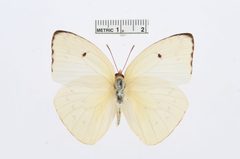
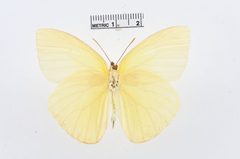
Wingspan 6.0–7.9 cm. Upper wing surface of males divided by ridges of androconial : outer half pale yellow, inner half brighter lemon yellow. Females lighter yellow to greenish-white with black borders at apex and outer margin, and a solid black spot. Underside of wings pale green or white with yellow at edges; females have pink to purple-brown spots and uneven borders on wing underside.
Habitat
Tropical scrubs, gardens, fields, and forest edges. Males typically found on river edges and open spaces; females more often in thinner forest areas and along forest edges. Occurs at high densities in core range, becoming rarer toward range margins.
Distribution
From southern Texas and Florida (USA) through Mexico, Central America, and the Caribbean to southern Brazil and northern Argentina. Also recorded in southern Georgia, New Mexico, and Kansas. Abundant in Amazon basin. Present on Antilles and other Caribbean islands.
Seasonality
active year-round in tropical regions. In Florida, occur from June through February. Peak activity May through July in tropics. Multiple per year, with first brood coinciding with start of rainy season.
Diet
Caterpillars feed on leaves of Fabaceae: coinvine (Dalbergia ecastophyllum), powder-puff (Calliandra), Cassia, Entada, and Callichamys; also Bignoniaceae including Xylophragma seemannianum in Rica. feed on nectar, preferentially from red-orange flowers including scarlet bush and . Males additionally drink from mud puddles.
Host Associations
- Dalbergia ecastophyllum - larval plantcoinvine, Fabaceae
- Calliandra - larval plantpowder-puff, Fabaceae
- Xylophragma seemannianum - larval plantwoody vine, Bignoniaceae, Rica
- Mandevilla tenuifolia - pollination mutualismpink flowering herb pollinated by butterflies including A. statira
Life Cycle
Two to three per year. Females oviposit singly on small young leaves of plants. Two larval forms exist: orange-green with dark blue band and orange (on Leguminosae), or pale green with thin yellow stripe and dark green head (on Bignoniaceae). Pupa gray to pale blue-green with thin yellow stripe and thin red line along dorsum.
Behavior
males most active before mid-morning, flying along hedges; during midday heat, fly at tree tops. Males form dense up to 100 individuals per square foot, sometimes mixed with other yellow (Rhabdodryas, Phoebis, Protesilaus). Caterpillars form large , sometimes clustering with other species for dilution.
Ecological Role
serve as , particularly of red-flowered plants. Documented as primary pollinator of Mandevilla tenuifolia, a -pollinated herb. Caterpillar can cause significant defoliation of plants.
Human Relevance
Subject of extensive research on navigation and orientation during . Studies in Panama demonstrated magnetic field sensitivity for navigation; experimental exposure to reversed magnetic fields caused opposite orientation. Also studied for sun compass use and landmark navigation.
Similar Taxa
- Phoebis sennaecloudless sulphur; similar yellow coloration and pattern, distinguished by wing shape and pattern details
- Rhabdodryas spp.similar yellow coloration; males sometimes found in mixed with A. statira
- Protesilaus spp.similar appearance; intermixed in male