
Phoebis agarithe
(Boisduval, 1836)
Large Orange Sulphur, Orange Giant Sulphur
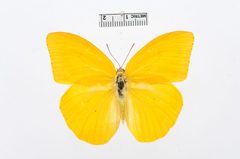
A medium to large sulphur of the Pieridae, ranging from Peru through Central America and the Caribbean to the southern United States. display bright orange upperwings with variable dark marginal markings. The exhibits strong and is frequently observed visiting flowers in open, disturbed . It has been introduced to Hawaii and occasionally strays northward well beyond its core range.
Pronunciation
How to pronounce Phoebis agarithe: //ˈfiːbɪs əˈɡærɪˌθiː//
These audio files are automatically generated. While they are not always 100% accurate, they are a good starting point.
Identification
Distinguished from the smaller Phoebis sennae (Cloudless Sulphur) by larger size, brighter orange color, and presence of dark marginal markings on forewing. Separated from Phoebis philea (Orange-barred Sulphur) by lack of orange bar on hindwing underside. Females may resemble female Phoebis argante but differ in wing shape and pattern details. In the United States, most likely to be confused with Phoebis sennae, from which it differs in color intensity and marking pattern.
Images
Appearance
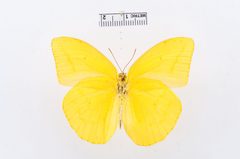
Wingspan 57–86 mm. Upper surface of wings bright orange with dark brown to blackish marginal band on forewing, more extensive in females. Hindwing typically lacks marginal markings. Underside pale yellow to orange with scattered dark spots. Sexes similar but females generally larger with more extensive dark markings. clubbed, typical of .
Habitat
Open tropical and subtropical lowlands including gardens, pastures, road edges, trails, parks, and disturbed areas. Occupies both natural and anthropogenic open . Not associated with closed forest.
Distribution
Native range extends from Peru north through Central America and the Caribbean to southern Texas and peninsular Florida. Rare strays documented as far north as Colorado, South Dakota, Wisconsin, and New Jersey. Introduced and established in Hawaii.
Seasonality
active year-round in tropical portions of range. In southern Texas, period primarily August to September. Seasonality in subtropical United States likely corresponds to warm months with peak activity late summer.
Diet
feed on flower nectar, with documented preference for , shepherd's needle, bougainvillea, rose periwinkle, Turk's cap, and hibiscus. Larvae feed on fresh leaves of Pithecellobium and Inga (Fabaceae).
Host Associations
- Pithecellobium - larval fresh leaves
- Inga - larval fresh leaves
Life Cycle
Complete with , larva, pupa, and stages. Larvae feed on leaves of plants in Fabaceae. Specific details of site and strategy not documented in sources.
Behavior
Strong, direct typical of . frequently observed nectaring at flowers. Males may engage in though this is not explicitly documented for this . Flight active during daylight hours.
Ecological Role
function as when nectaring. Larvae serve as herbivores on legumes. Specific ecological interactions beyond these general roles not documented.
Human Relevance
Occasional garden visitor valued for bright coloration. Introduced to Hawaii, presumably for aesthetic purposes. Not known to be economically significant as pest or beneficial . Subject of watching and photography.
Similar Taxa
- Phoebis sennaeSimilar size and use; differs in pale yellow to greenish coloration lacking dark forewing margins, and smaller average size
- Phoebis phileaSimilar orange coloration; distinguished by presence of orange bar on hindwing underside and different wing shape
- Phoebis arganteFemales may resemble female P. agarithe; differs in wing pattern details and geographic distribution
More Details
Subspecies
Multiple recognized with varying distributions: P. a. agarithe (Texas, Mexico), P. a. fischeri (Baja California), P. a. maxima (Florida), P. a. antillia (Haiti), P. a. pupillata (Dominica), P. a. tumbesina (Peru)
Introduction History
Established in Hawaii through intentional introduction; specific date and circumstances not documented in available sources
Vagrancy
Northward strays to Colorado, South Dakota, Wisconsin, and New Jersey represent exceptional events rather than regular range expansion