
Gyrocheilus patrobas
(Hewitson, 1862)
Red-bordered Satyr, Red-bordered Brown
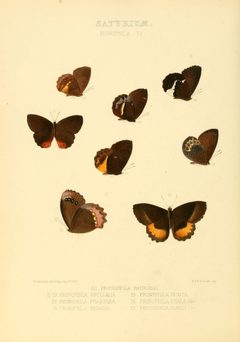
Gyrocheilus patrobas, the Red-bordered Satyr or Red-bordered Brown, is the sole in the Gyrocheilus. This is found in montane regions of the southwestern United States and Mexico, where it inhabits streamsides in open coniferous forests. The species is a member of the Satyrinae, a group known for eyespot patterns and association with grassy or wooded .
Pronunciation
How to pronounce Gyrocheilus patrobas: /dʒaɪroʊˈkaɪləs ˈpætroʊbæs/
These audio files are automatically generated. While they are not always 100% accurate, they are a good starting point.
Identification
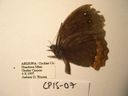
Distinguished from other regional satyrs by the combination of: reddish-orange marginal band on the hindwing underside (the 'red border' for which it is named); relatively plain brown wing surfaces without prominent eyespots; and restriction to higher-elevation coniferous forest streamsides in its range. The Gyrocheilus is , so identification to genus level confirms the . Similar satyrs in the region (e.g., Cercyonis, Coenonympha) lack the distinctive red hindwing border and typically occupy different .
Images
Habitat
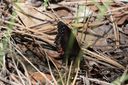
Streamsides in open coniferous forests in mountainous areas. Associated with riparian zones within pine or mixed conifer woodlands at moderate to high elevations.
Distribution
North America: central and southern Arizona, southward into Mexico. Present in montane regions of the southwestern United States and Mexican highlands.
Similar Taxa
- Cercyonis spp.Regional satyrs with brown coloration and eyespot patterns, but lack the red hindwing border and occupy lower-elevation or more open
- Coenonympha tullus (Common Ringlet)Similar size and brown coloration, but has more angular wings, distinct eyespot patterns, and occurs in grasslands rather than coniferous forest streamsides
- Satyrium spp.Hairstreaks with hindwing tails and different wing shape; often found in similar montane but readily distinguished by
More Details
Taxonomic notes
The Gyrocheilus was established as , with G. patrobas as its only member. The was originally described as Pronophila patrobas by Hewitson in 1862. Its placement in Satyrinae reflects morphological and molecular affinities with the 'true' satyr butterflies, though its precise tribal relationships within Satyrini have been subject to revision.
Conservation status
Not formally assessed by IUCN. The appears to have a restricted but stable range in montane ; potential sensitivity to climate change and forest management practices in southwestern U.S. riparian zones.