
Anaea
Hübner, 1819
leafwing butterflies, goatweed butterflies
Species Guides
3- Anaea aidea(Tropical Leafwing)
- Anaea andria(Goatweed Leafwing)
- Anaea troglodyta(Florida leafwing)
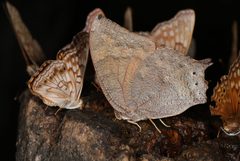
Anaea is a of Neotropical leafwing butterflies in the Nymphalidae, tribe Anaeini. are renowned for their cryptic coloration, with wing undersides that mimic dead leaves. The genus is primarily associated with Croton species (Euphorbiaceae) as larval plants. Anaea butterflies exhibit seasonal dimorphism and host plant segregation among sympatric species. Several species are of conservation concern, including the federally endangered Anaea troglodyta floridalis in Florida.
Pronunciation
How to pronounce Anaea: //ˈæn.i.ə//
These audio files are automatically generated. While they are not always 100% accurate, they are a good starting point.
Identification
Distinguished from other Charaxinae by the dead-leaf mimicry of wing undersides combined with association with Croton plants. Similar dead-leaf butterflies in the Old World (Kallima) belong to different . Within Anaea, identification requires examination of wing pattern details, genitalia, and host plant association. Sympatric species in Brazil segregate by host plant species and vertical stratification: A. otrere on saplings, A. ryphea on saplings/shrubs, A. appias and A. arginussa on shrubs/trees.
Images
Appearance
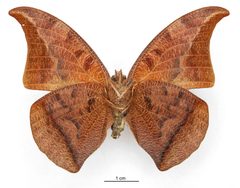
Medium-sized butterflies with cryptic coloration. Upper wing surfaces typically dark brown, orange-brown, or tawny with variable markings. Wing undersides are the defining feature: colored in earth tones of brown, gray, or green with intricate patterns that mimic dead leaves, including -like markings resembling leaf midribs. Some have notched or angular wing margins enhancing the leaf-like silhouette. have reduced front legs characteristic of Nymphalidae. Seasonal forms differ in size and color intensity.
Habitat
Tropical and subtropical forests, particularly semideciduous forests. In Florida, restricted to pine rockland and hardwood hammock . frequent forest and edges where plants occur. stages found on specific Croton host plants at particular phenological stages: saplings, shrubs, or tree leaves depending on .
Distribution
Neotropical distribution from southern United States (southern Florida, southern Texas) through Mexico, Central America, and South America. In the United States, A. andria occurs in the southern Midwest and South; A. troglodyta floridalis is restricted to southern Florida pine rocklands.
Seasonality
active year-round in tropical ; in temperate regions, active spring through fall with peak abundance in late summer and autumn. Seasonal dimorphism present: wet season/dry season forms in tropics; summer/fall forms in subtropical regions. Reproductive occurs in seasonal forms influenced by larval .
Diet
Larvae are obligate feeders on Croton (Euphorbiaceae), including C. alchorneicarpus, C. floribundus, C. salutaris, and C. linearis. Specific plant associations vary by species. feed on rotting fruit, tree sap, and possibly ; attracted to rotting banana in field studies.
Host Associations
- Croton alchorneicarpus - larval used by A. ryphea in Brazil
- Croton floribundus - larval used by three Anaea in Brazil
- Croton salutaris - larval used by four Anaea in Brazil
- Croton linearis - larval critical for A. troglodyta floridalis in Florida
Life Cycle
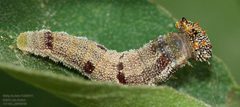
laid singly on underside of plant leaves. Early instar larvae (first to third) construct chains on leaf for shelter. Late instar larvae (fourth and fifth) roll leaves into tubular shelters held with silk. occurs within the leaf shelter. Immatures identifiable to from third instar onward. Development time varies with season and host plant quality.
Behavior
exhibit strong cryptic , resting with wings closed to display leaf-mimicking undersides. Often rest on leaf undersides or among dead leaves. When disturbed, may remain motionless relying on camouflage. Males establish territories and perch on plants or nearby vegetation. Adults are more frequent in forest than understory; in Brazil, trapped at 5m height more often than 1m. is rapid and erratic when disturbed, then settling quickly to resume .
Ecological Role
Herbivore guild member specializing on Croton; contributes to leaf damage and nutrient cycling in tropical forest . Part of Charaxinae in forest and understory. Serves as prey for birds, spiders, and . Potential of rotting fruit resources.
Human Relevance
Several of conservation concern due to loss. Anaea troglodyta floridalis (Florida leafwing) is federally endangered, dependent on pine rockland habitats and Croton linearis plant in Miami-Dade County. Anaea andria (goatweed ) has experienced impacts from habitat loss in the southern United States. Popular in butterfly conservatories and exhibits for educational value of . Subject of ecological research on host plant specialization and guild structure.
Similar Taxa
- KallimaOld World dead-leaf butterflies with similar but in Nymphalinae rather than Charaxinae; different geographic range and plants
- Siproeta stelenesMalachite in Nymphalinae with similar size and color but lacks dead-leaf mimicry on wing undersides; different plant
- MemphisRelated in Anaeini with similar leafwing but different wing patterns and plant associations
More Details
Host plant segregation
Sympatric Anaea in Brazilian forests exhibit fine- partitioning of Croton plants by species and plant phenological stage, reducing
Conservation status
A. troglodyta floridalis critically endangered with only a few remaining in Miami-Dade County pine rocklands; dependent on prescribed fire management to maintain plant
Sources and further reading
- BugGuide
- Wikipedia
- GBIF taxonomy match
- iNaturalist taxon
- NCBI Taxonomy
- Catalogue of Life
- Bug Eric: Grand Finale
- Bug Eric: More Magic
- Bug Eric: 2024
- Bug Eric: 2009
- Host plant use among closely related Anaea butterfly species (Lepidoptera, Nymphalidae, Charaxinae)
- Goatweed Butterfly, Goatweed Emperor, Goatweed Leafwing Anaea andria Scudder (1875) (Insecta: Lepidoptera: Nymphalidae: Charaxinae)
- Notes on the Status and Ecology ofAnaea troglodyta floridalis(Nymphalidae) in Everglades National Park
- Distribution ofCroton linearisin Miami-Dade County Preserves with Potential for Supporting the Federally Endangered ButterfliesStrymon acis bartramiandAnaea troglodyta floridalis