
Anaea aidea
(Guérin-Méneville, 1844)
Tropical Leafwing
Anaea aidea, commonly known as the tropical leafwing, is a in the Charaxinae. It occurs from Mexico to northwestern Rica, with occasional strays reaching the southern United States. The has a wingspan of 57–78 mm and is recognized for its leaf-like wing appearance. Some taxonomic treatments consider it a of Anaea troglodyta.
Pronunciation
How to pronounce Anaea aidea: /ˈæn.iː.ə aɪˈdiː.ə/
These audio files are automatically generated. While they are not always 100% accurate, they are a good starting point.
Identification
Distinguished from similar leafwing butterflies by its specific geographic range (primarily Mexican and Central American, with rare northern strays). The combination of leaf-mimicking wing shape and orange-brown upper surface separates it from other Nymphalidae in the same region. May be confused with Anaea troglodyta, with which it has been synonymized by some authors; separation requires examination of subtle wing pattern differences and geographic origin.
Images
Appearance
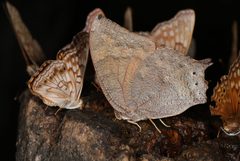
Wingspan 57–78 mm. Wings are broad and leaf-shaped, with cryptic coloration resembling dead leaves when the is at rest with wings closed. Upper wing surface is typically orange-brown with darker markings. The overall form provides effective camouflage against foliage.
Habitat
Tropical and subtropical forested environments. Specific microhabitat preferences are not well documented in available sources.
Distribution
Native range extends from Mexico to northwestern Rica. Strays have been recorded in southern Texas, Arizona, and California in the United States. GBIF records confirm presence in North America.
Diet
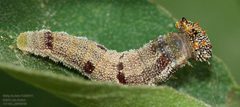
Larvae feed on of Croton (Euphorbiaceae). feeding habits are not documented in available sources.
Life Cycle
Complete with , larva, pupa, and stages. Larval plants are Croton . Specific details on sites, number of , or developmental timing are not documented in available sources.
Behavior
Has been observed to rest with wings closed, displaying cryptic underside that resembles a dead leaf. This enhances the effectiveness of its leaf mimicry for avoidance. Other specific behavioral observations are not documented in available sources.
Ecological Role
Larvae function as herbivores on Croton . likely serve as , though this has not been specifically documented. The species participates in as prey for such as birds and arthropods.
Human Relevance
Occasional attraction for watchers in southern Texas and the southwestern United States due to its status as a rare stray. No documented economic or agricultural significance.
Similar Taxa
- Anaea troglodytaSome authors consider A. aidea to be a of A. troglodyta; the two are very similar in appearance and require careful examination for separation
More Details
Taxonomic Uncertainty
The status of Anaea aidea is disputed; some taxonomic treatments treat it as a of Anaea troglodyta rather than a full species.