
Anaeini
Genus Guides
4- Anaea(leafwing butterflies)
- Fountainea
- Hypna(jazzy leafwing)
- Memphis
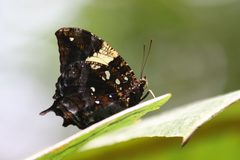
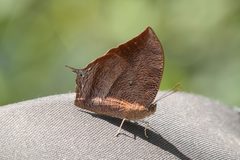
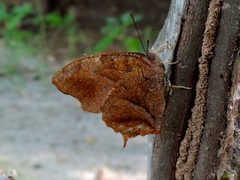
Anaeini is a tribe of brush-footed butterflies in the Nymphalidae, Charaxinae. These Neotropical butterflies are renowned for their remarkable dead leaf mimicry: when at rest with wings closed, the undersides closely resemble dried, brown foliage. The tribe includes approximately nine , among them Anaea, Memphis, Fountainea, Zaretis, and Hypna. Some taxonomic uncertainty exists regarding the placement of Anaeomorpha, which is sometimes included in Anaeini but more frequently assigned to the related tribe Preponini.
Pronunciation
How to pronounce Anaeini: /ˌæn.iˈaɪ.naɪ/
These audio files are automatically generated. While they are not always 100% accurate, they are a good starting point.
Identification
Anaeini butterflies are most readily identified by their dead leaf mimicry when at rest—wings held vertically together, undersides exposed, presenting a convincing dried leaf appearance. This distinguishes them from superficially similar Charaxinae in other tribes (e.g., Preponini) which typically display more metallic upper surfaces and different underside patterns. Within Anaeini, may be distinguished by wing shape: Anaea and Memphis often have more angular or tailed forewings; Fountainea typically shows more rounded margins; Zaretis species possess distinctive notched forewing apices. Specimen examination or high-quality photographs of both wing surfaces are usually required for species-level identification.
Images
Habitat
Primarily tropical and subtropical forests from lowland rainforests to montane cloud forests. frequent forest understory, edges, and clearings where they perch on tree trunks and vegetation with wings closed, enhancing their cryptic appearance. Larval plants are in the Anacardiaceae, particularly Spondias and Pseudospondias.
Distribution
Exclusively Neotropical, ranging from Mexico through Central America and the Caribbean to South America as far south as northern Argentina. Greatest diversity in the Amazon basin and Atlantic forests of Brazil. Some extend into subtropical regions of Mexico and the southern United States (Florida, Texas) as rare strays or localized .
Seasonality
fly year-round in equatorial regions with peak abundance varying locally. In seasonal forests, activity concentrated during wet season when plant foliage is abundant. Some exhibit fluctuations tied to fruiting cycles of host trees.
Host Associations
- Anacardiaceae - larval plant Primary ; larvae feed on leaves of Spondias, Pseudospondias, and related
Life Cycle
Complete with four stages: , larva, pupa, . Eggs laid singly on plant leaves. Larvae feed externally on foliage, resting along leaf midribs where their cryptic coloration provides protection. occurs on host plants or nearby vegetation; chrysalids often resemble dead leaves or twigs, extending the camouflage strategy across life stages. Adults emerge and may live several weeks to months, feeding primarily on rotting fruit, tree sap, and occasionally nectar.
Behavior
are primarily or active in shaded forest conditions, flying with a characteristic slow, gliding motion. When disturbed, they typically seek perches on tree trunks or among dead leaves, closing wings to display cryptic undersides. Some have been observed feeding at carrion and mammal . Males establish territories and perch on prominent branches to intercept females. Roosting involves clustering on vegetation, sometimes in mixed-species .
Ecological Role
Larvae function as herbivores, consuming foliage of Anacardiaceae trees and contributing to nutrient cycling in forest . serve as to a limited degree through incidental pollen transfer while feeding at flowers, though their primary food sources (rotting fruit, sap flows) make them more significant as consumers of decaying organic matter. They provide prey for birds, lizards, and , with their cryptic coloration representing a key anti-predator .
Human Relevance
Popular among collectors and photographers due to their striking dead leaf mimicry. Some are displayed in butterfly conservatories and exhibits. Occasionally referenced in biomimicry research for applications in camouflage technology. No significant agricultural impact; larvae do not reach pest status on cultivated Anacardiaceae (cashew, mango) due to natural enemy regulation and limited densities.
Similar Taxa
- PreponiniAlso Charaxinae with leaf-mimicking undersides, but typically display strong metallic blue or green iridescence on upper wing surfaces and have different wing venation and body proportions. Anaeomorpha, sometimes placed in Anaeini, is now generally assigned to Preponini based on morphological and molecular evidence.
- Kallima (Nymphalinae)Old World 'dead leaf butterflies' with convergent dead leaf mimicry; distinguished by geographic range (Asia, Africa), different wing shape with more pronounced leaf-like petiole 'stalk', and placement in Nymphalinae rather than Charaxinae.
More Details
Taxonomic History
The Memphis was historically submerged within Anaea but has been resurrected based on phylogenetic studies. Fountainea likewise was separated from Anaea. These revisions reflect ongoing work to align classification with evolutionary relationships. The tribal boundaries within Charaxinae remain an active area of research, with molecular data increasingly supplementing traditional morphological characters.
Etymology
The tribe name derives from the type Anaea, established by Hübner in 1819. The genus name itself appears to be of unclear etymological origin, possibly a Latinized form of an unknown proper name.