
Fountainea
Rydon, 1971
Species Guides
1- Fountainea glycerium(Angled Leafwing)
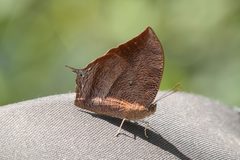
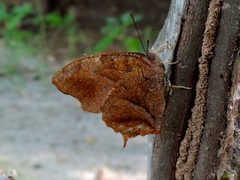
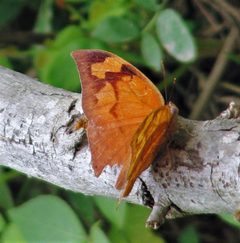
Fountainea is a of Neotropical leaf butterflies in the Nymphalidae, established by Rydon in 1971. The genus contains eight known for their remarkable camouflage: when at rest with wings closed, their undersides closely resemble dead leaves. The genus was named in honor of Margaret Fountaine, a renowned entomologist. These butterflies are part of the Charaxinae , a group known for their robust bodies and often cryptic wing patterns.
Pronunciation
How to pronounce Fountainea: /faʊnˈtaɪniə/
These audio files are automatically generated. While they are not always 100% accurate, they are a good starting point.
Identification
Distinguished from other leaf-mimic butterflies by specific wing shape and pattern details on the underside. The Fountainea is part of the Anaeini tribe within Charaxinae, which includes other leafwing genera such as Anaea and Memphis. Accurate identification to level requires examination of specific wing patterns, particularly the configuration of the leaf- mimicry on the hindwing underside and the shape of the wing margins. The genus can be separated from similar leaf-mimic genera by genitalic characters and specific wing venation patterns.
Images
Appearance
Medium-sized butterflies with robust bodies typical of the Charaxinae . The upper wing surfaces are often brightly colored or patterned, while the undersides are cryptically colored in earth tones of brown, gray, and green. When wings are closed at rest, the undersides closely mimic dead leaves, often with detailed markings resembling leaf , midribs, and even simulated fungal spots or damage. The wing shape itself contributes to the leaf-like illusion, with irregular margins that suggest a dried, curled leaf.
Habitat
Tropical and subtropical forest in the Neotropical region. These butterflies are typically found in forested areas where their leaf-mimicry provides effective camouflage among fallen leaves on the forest floor or among foliage.
Distribution
Neotropical region, ranging from Mexico through Central America and into South America. Specific distribution varies by within the . Records include Ecuador (Reserva Ecológica Arenillas).
Diet
feed on rotting fruit, tree sap, and other non-floral liquid sources typical of Charaxinae butterflies. Larval plants are in the Anacardiaceae, including of Spondias and related .
Host Associations
- Spondias - larval plant in Anacardiaceae used by larvae
- Anacardiaceae - larval plant containing primary larval food plants
Life Cycle
Complete with , larva, pupa, and stages. Larvae feed on leaves of plants in Anacardiaceae. occurs on the host plant or nearby vegetation. Adults are long-lived compared to many butterflies, with extended periods of dormancy or inactivity during which they rely on their cryptic coloration for protection.
Behavior
spend much of their time at rest with wings closed, relying on leaf-mimicry for avoidance. When active, they fly in direct, rapid . They are known to visit rotting fruit, sap flows, and other non-floral food sources. Males may establish territories and perch on branches to await females.
Ecological Role
serve as to a limited extent when visiting flowers, though their primary food sources are non-floral. Larvae function as herbivores, consuming leaves of plants. The contributes to biodiversity in Neotropical forest and serves as prey for various including birds and arthropods, with their remarkable camouflage representing an evolutionary response to pressure.
Human Relevance
Primarily of interest to entomologists, lepidopterists, and ecologists studying mimicry and camouflage. The is named after Margaret Fountaine (1862–1940), a pioneering British entomologist known for her extensive collections and travels. Specimens are represented in museum collections worldwide, including the Bohart Museum of Entomology at UC Davis. No significant economic importance as pests or beneficial .
Similar Taxa
- AnaeaSimilar leaf-mimic butterflies in the same tribe Anaeini; historically some Fountainea were classified in Anaea
- MemphisAnother of leafwing butterflies in tribe Anaeini with similar dead leaf mimicry
- KallimaOld World leafwing butterflies with convergent dead leaf mimicry, but in Nymphalidae Nymphalinae rather than Charaxinae
More Details
Etymology
The name Fountainea honors Margaret Fountaine (1862–1940), a British entomologist, diarist, and traveler who collected extensively in Europe, South Africa, India, Tibet, Australia, and the Americas. She amassed one of the largest private collections of her era, with over 22,000 specimens now housed at the Norwich Castle Museum.
Taxonomic history
The was established by A.H.B. Rydon in 1971 as part of his revision of the Charaxidae (now treated as Charaxinae). Rydon's work reorganized the classification of leafwing butterflies, separating Fountainea from the related genus Anaea based on morphological characters including genitalic structure and wing venation patterns.
Mimicry and crypsis
The dead leaf mimicry exhibited by Fountainea represents a sophisticated form of . The wing undersides not only match the coloration of dead leaves but also simulate specific details such as fungal spots, insect damage, and the three-dimensional appearance of a curled, dried leaf. This camouflage is effective against visually hunting including birds and lizards.