
Eumaeus atala
(Poey, 1832)
Atala, Atala butterfly, Atala hairstreak, coontie hairstreak
The Atala is a small, colorful lycaenid butterfly unique within its range for its aposematic coloration and exclusive association with cycad plants. Once considered the most conspicuous insect in South Florida in 1888, it was believed extinct by the 1950s due to overharvesting of its sole native host plant, coontie (Zamia integrifolia), for starch production. Rediscovered in 1979 on a Miami barrier island, the has recovered dramatically through conservation efforts and the popularity of coontie as an ornamental landscape plant, becoming common enough in southeast Florida to occasionally be regarded as a pest. The butterfly sequesters toxic cycasin compounds from its host, rendering all life stages unpalatable to .
Pronunciation
How to pronounce Eumaeus atala: //juːˈmeɪəs əˈtɑːlə//
These audio files are automatically generated. While they are not always 100% accurate, they are a good starting point.
Identification
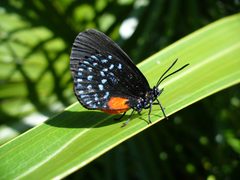
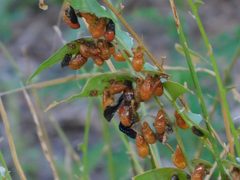
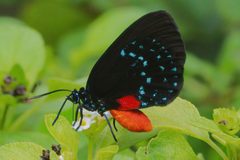
Distinguished from other eastern hairstreaks by its larger size and striking coloration: display black wings with iridescent blue-green scaling on the hindwings, bright red , and red spots near the wing margins. Larvae are equally distinctive with bright red, yellow, and black banding. The slow, deliberate contrasts sharply with the rapid, erratic flight of other Lycaenidae. No other in its range exhibits this combination of warning coloration and cycad association.
Images
Habitat
Native consists of open brushy areas, tropical hammocks, and pine rocklands in southeastern Florida, including the Florida Keys; fire-dependent where coontie naturally occurs. Following recovery, now thrive in suburban landscapes, gardens, and ornamental plant nurseries where coontie is cultivated as a landscape plant.
Distribution
Southeastern Florida (including Florida Keys) in the United States; Cuba; the Bahamas; and the Cayman Islands. Historically not collected in Florida from 1937 to 1959. Reintroduction efforts have established at Zoo Miami and Disney's Vero Beach Resort.
Seasonality
fly through much of the year in southern Florida; multivoltine in southern portions of range, seasonal in northern areas. Year-round activity possible where plants and climate permit.
Diet
Larvae feed exclusively on cycad leaves, primarily Zamia integrifolia (coontie) in its native range, and Zamia pumila; also accepts ornamental cycads including Cycas revoluta in Cuba and cultivated Zamia . Newly hatched larvae require soft, fresh growth and cannot consume mature, leathery leaves. take flower nectar.
Host Associations
- Zamia integrifolia - primary native plantsole native cycad in North America; exclusive for oviposition and larval development in Florida
- Zamia pumila - plantnative cycad used in parts of range
- Cycas revoluta - plantintroduced ornamental cycad consumed in Cuba
- Zamia erosa - occasional other cycad documented (personal communication)
Life Cycle
Complete : , larva, pupa, . Eggs laid in clusters of 10-50 on leaf tips of plant. Larvae feed on host leaves, with early instars requiring fresh, soft growth; larger larvae can consume mature foliage. typically occurs on the host plant. Pupal stage capable of sound production. Typical egg hatch rate approximately 51%. Development from larva to pupa shows no significant difference between freeze-dried and fresh host plant diets.
Behavior
Males maintain territories near plant sites, often forming small colonies of a few individuals; females disperse to locate additional host plants. Males possess hair-pencils (coremata) on the used in courtship, hovering before females while wafting . sometimes roost in trees. Larvae use 'bridges' of mature leaves or sticks to move between feeding locations. All life stages exhibit aposematic , advertising unpalatability through bright coloration. is notably slow and deliberate compared to other lycaenids.
Ecological Role
Herbivore specialized on cycads; contributes to pollination as nectar-feeding . Serves as flagship for pine rockland and coontie conservation. Chemical defense through cycasin provides example of acquired in Lepidoptera. recovery demonstrates successful conservation through plant restoration and urban creation.
Human Relevance
Subject of intensive conservation efforts following near-extinction; successful recovery through captive breeding and reintroduction programs has released over 3,400 individuals to the wild. Now occasionally considered a pest in ornamental plant nurseries and gardens where larvae defoliate expensive cycad plantings. approaches involve relocating unwanted colonies to gardens that actively seek to the . Popular among enthusiasts and native plant gardeners; encourages planting of native coontie in Florida landscapes.
Similar Taxa
- Eumaeus minyasCongeneric with similar cycad association and aposematic coloration; distinguished by distribution and minor morphological differences in wing pattern
- Strymon acis (Bartram's Scrub-hairstreak)Shares pine rockland in Florida and is similarly endangered; much smaller, lacks bright red abdominal coloration, and has different plant associations
- Other Lycaenidae hairstreaksDistinguished by Atala's larger size, unique red-and-black coloration, slow , and exclusive cycad association; other hairstreaks typically have tails on hindwings and faster, erratic flight
More Details
Conservation History
The represents one of North America's most dramatic conservation stories. From abundance to presumed extinction to recovery as a potential pest, the trajectory illustrates both the vulnerability of herbivores to plant decline and the potential for urban landscapes to support conservation. The 1979 rediscovery on a Miami barrier island appears to be the source of all current South Florida . Ex situ breeding programs utilized innovative freeze-dried host plant diets to maintain colonies year-round when fresh growth was unavailable, enabling 859 days of continuous breeding and significant release numbers.
Chemical Defense
The 's bright coloration advertises its acquired through of cycasin, a neurotoxic glycoside present in all cycad tissues. This makes larvae and unpalatable to vertebrate including birds and lizards, which learn to avoid these conspicuous insects after initial distasteful encounters. The defense is retained through , protecting all life stages.
Etymology
Named by Cuban zoologist Felipe Poey in 1832 for Atala, the Native American heroine of François-René de Chateaubriand's 1801 French novella 'Atala, ou Les Amours de deux sauvages dans le désert' ('Atala, or the Loves of two Indian savages in the desert').
Sources and further reading
- BugGuide
- Wikipedia
- GBIF taxonomy match
- iNaturalist taxon
- NCBI Taxonomy
- Catalogue of Life
- Two Insect Contests: One Winner, One to Go | Bug Squad
- A Nearly Extinct Butterfly Makes a Comeback in South Florida
- Destination Lizard Island, Australia, and a visit with Green Tree Ants, Oecophylla smaragdina — Bug of the Week
- Bug Eric: Losing the Pine Rocklands
- Bug of the Week Academy Awards 2018 — Bug of the Week
- Archive — Bug of the Week
- Atala, Atala Hairstreak, Coontie Hairstreak, Eumaeus atala Röber (Insecta: Lepidoptera: Lycaenidae)
- Atala Butterfly, Atala Hairstreak, Coontie Hairstreak, Eumaeus atala Poey 1832 (Insecta: Lepidoptera: Lycaenidae)
- A modified diet to support conservation of the Atala hairstreak butterfly (Eumaeus atala Poey)
- Life History Variations and Seasonal Polyphenism in Eumaeus atala (Lepidoptera: Lycaenidae)
- New and Revised Life History of the Florida HairstreakEumaeus atala(Lepidoptera: Lycaenidae) with Notes on its Current Conservation Status