
Erynnis persius
(Scudder, 1863)
Persius Duskywing
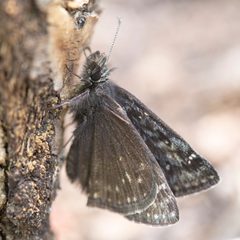
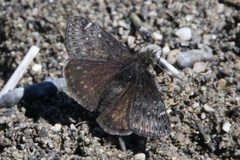
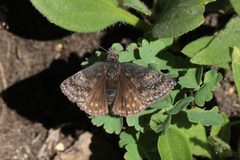
Erynnis persius, the Persius duskywing, is a in the Hesperiidae native to North America. The species exhibits a single with larvae hibernating and pupating in spring. The eastern E. p. persius is of particular conservation concern, being rare and in severe decline due to loss and decline of its obligate plant, wild blue lupine (Lupinus perennis). are difficult to distinguish from other duskywing skippers without close examination.
Pronunciation
How to pronounce Erynnis persius: /ˈɛɹ.ɪn.ɪs ˈpɝ.si.əs/
These audio files are automatically generated. While they are not always 100% accurate, they are a good starting point.
Identification
Difficult to distinguish from other Erynnis duskywing skippers. Examination of wing pattern details and, for females, presence of the scent patch on the 7th abdominal segment may assist identification. Males distinguished by raised white hairs on forewings. Regional occurrence and association with specific plants may provide contextual clues.
Images
Habitat
Associated with open supporting larval plants, particularly leguminous vegetation. Eastern tied to habitats supporting wild blue lupine (Lupinus perennis), including sandplain grasslands and pine barrens. Western populations use a broader range of legume hosts in various open habitats.
Distribution
North America, ranging from Alaska and western Canada (Alberta, Saskatchewan, Manitoba) across the western United States to Arizona and New Mexico. Eastern extends from New England west to Wisconsin and south to Virginia. Eastern E. p. persius historically occurred in Ontario but is thought to be extirpated there.
Seasonality
Single . active in late spring and early summer. Mature larvae hibernate, with occurring between April and June.
Diet
Larvae feed on leguminous plants including Lupinus (lupines), Thermopsis (golden banner), Lotus, and other Fabaceae. Eastern E. p. persius is dependent on wild blue lupine (Lupinus perennis). feed on flower nectar.
Host Associations
- Lupinus perennis - larval plantObligate for eastern E. p. persius; critical for conservation
- Lupinus - larval plant-level for broader
- Thermopsis - larval plantGolden banner
- Lotus - larval plant
- Fabaceae - larval plant-level association
Life Cycle
Single (). Mature larva hibernates through winter. occurs between April and June. Males seek females by perching on ground or low vegetation. Females lay on plant vegetation.
Behavior
Males perch on ground or low vegetation to seek females. visit flowers for nectar.
Ecological Role
may contribute to pollination while nectaring. Larvae function as herbivores on leguminous plants. Serves as an for quality in sandplain and pine barrens , particularly in the eastern portion of its range.
Human Relevance
Subject to legal protection in multiple jurisdictions due to rarity of eastern . Listed as threatened in Michigan, endangered in Minnesota, Ohio, New York, New Hampshire, and Connecticut. Listed as endangered in Canada under the at Risk Act. Decline attributed to destruction, loss of wild blue lupine plant, and spraying for spongy moth (Lymantria dispar) control. Conservation efforts focus on habitat restoration and host plant management.
Similar Taxa
- Other Erynnis speciesDuskywing skippers are notoriously difficult to distinguish; E. persius requires careful examination of wing patterns and male/female-specific traits
- Erynnis tagesDingy Skipper, mentioned in grassland index context as declining with similar ecological profile in European studies
More Details
Conservation Status
The is globally secure, but the eastern E. p. persius is rare and declining. Specific threats include destruction and alteration, decline of wild blue lupine, and applications. The subspecies is protected under various state and federal laws in the United States and Canada.
Taxonomic Note
Recognized E. p. persius in the eastern portion of the range, which shows greater conservation concern and plant specialization compared to western .