
Erynnis
Schrank, 1801
duskywings, duskywing skippers
Species Guides
17- Erynnis afranius(Afranius Duskywing)
- Erynnis baptisiae(wild indigo duskywing)
- Erynnis brizo(Sleepy Duskywing)
- Erynnis funeralis(Funereal Duskywing)
- Erynnis horatius(Horace's duskywing)
- Erynnis icelus(Dreamy Duskywing)
- Erynnis juvenalis(Juvenal's Duskywing)
- Erynnis lucilius(Columbine Duskywing)
- Erynnis martialis(Mottled Duskywing)
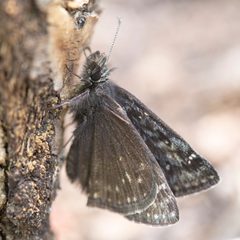
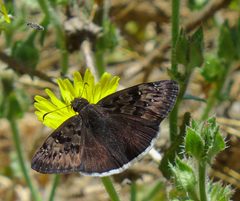
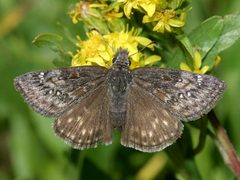
Erynnis is a of skippers in the Hesperiidae, commonly known as duskywings. The genus exhibits high in the Nearctic region, with also present across the Palearctic and Neotropical ecozones. Duskywings are medium-sized, fast-flying butterflies with dark, often brown or blackish wings that typically lack bright coloration. Many species are difficult to distinguish from one another and require examination of wing pattern details or genitalia for reliable identification.
Pronunciation
How to pronounce Erynnis: //əˈrɪn.nɪs//
These audio files are automatically generated. While they are not always 100% accurate, they are a good starting point.
Identification
Identification to level is notoriously difficult and often requires examination of the underside of the hindwing. Erynnis juvenalis has one or two dots on the hindwing that E. horatius lacks. E. propertius flies early in the season. E. brizo and E. funeralis can be distinguished by and wing markings. E. tages is a Palearctic species associated with grassland habitats. When possible, specimens should be compared with reference collections or expert-verified photographs.
Images
Habitat
Found in diverse including open woodlands, forest edges, prairies, glades, fens, riparian corridors, and grasslands. Specific habitat associations vary by ; some require oak woodlands, others prefer grasslands or wetland edges.
Distribution
Highest in the Nearctic ecozone (North America). Present across the Palearctic (Europe, Asia) and in the Neotropical ecozone. Specific distribution records include Denmark, Norway, Sweden, Vermont (USA), and other US states.
Seasonality
periods vary by and region. Erynnis juvenalis and E. horatius fly in early spring. E. propertius emerges early, with records from late January in California. E. horatius continues flying through summer. E. brizo appears in spring at lower elevations. E. funeralis is present in spring in the southwestern United States.
Diet
Larvae feed on various plants including oaks (Quercus), legumes, and other woody plants. Specific host associations vary by : E. brizo feeds on oak; E. funeralis likely uses legumes and other plants.
Host Associations
- Quercus - larval Erynnis brizo and other
- Fabaceae - larval Erynnis funeralis and others
Life Cycle
Complete with , larva, pupa, and stages. Larvae are leaf-rollers or leaf-tiers on plants. stage varies by ; some overwinter as pupae, others as partially grown larvae.
Behavior
Males of many exhibit territorial , perching on prominent objects and darting out to chase females or rival males. have rapid, erratic patterns typical of skippers. Some species visit flowers for nectar; others are rarely observed nectaring.
Ecological Role
may serve as when visiting flowers. Larvae function as herbivores, consuming leaves of plants. The includes used as indicators of grassland health, such as Erynnis tages in European monitoring programs.
Human Relevance
Used as bioindicators for quality and monitoring, particularly in grassland conservation assessment. The Grassland Index for Germany includes Erynnis tages as one of 15 . Some are of interest to butterfly watchers and photographers, though identification challenges limit recreational appeal.
Similar Taxa
- Other Pyrginae skippersSimilar dark coloration and rapid ; distinguished by wing pattern details, preferences, and often requiring genitalia examination for definitive identification
- Staphylus (scallopwings)Similar small size and dark coloration; scallopwings have distinctive wing margins and different clubs
- Systasea (powdered-skippers)Similar dark, muted appearance; powdered-skippers have distinctive wing scaling and pattern
More Details
Conservation status
Erynnis tages (Dingy Skipper) has shown significant decline in Germany between 2006 and 2023 according to the Grassland Index. Declines attributed to loss, fragmentation, intensive mowing, nitrogen inputs, and . Climate change increasingly affects distribution and abundance across the .
Taxonomic challenges
The is considered one of the most taxonomically difficult groups of North American butterflies. Many are cryptic and require examination of genitalia or detailed wing pattern analysis. Some species pairs cannot be reliably separated from photographs of the wing surface alone.
Sources and further reading
- BugGuide
- GBIF taxonomy match
- iNaturalist taxon
- NCBI Taxonomy
- Catalogue of Life
- 'Battus philenor! Battus philenor!' | Bug Squad
- Drama in the Pollinator Patch | Bug Squad
- Bug Eric: Spring (Butterfly) Beauties
- Oedemeridae | Beetles In The Bush
- Grassland butterflies: important indicators of the state of nature
- Bug Eric: Emerald Valley, 2016