
Agathymus
Freeman, 1959
giant-skippers
Species Guides
9- Agathymus alliae(Mojave giant skipper)
- Agathymus aryxna(Arizona Giant-Skipper)
- Agathymus baueri(Bauer's Giant-Skipper)
- Agathymus evansi(Huachuca Giant-Skipper)
- Agathymus mariae(lechuguilla giant skipper)
- Agathymus neumoegeni(orange giant-skipper)
- Agathymus polingi(Poling's Giant-Skipper)
- Agathymus remingtoni(Remington's Giant-Skipper)
- Agathymus stephensi(California giant skipper)
Agathymus is a of large described by H.A. Freeman in 1959. The genus comprises approximately 30 distributed across arid regions of North America from the southwestern United States through Mexico to Rica. Larvae are specialized stem-borers in agave plants, making this genus ecologically dependent on desert agave . Species are commonly known as giant-skippers.
Pronunciation
How to pronounce Agathymus: //əˈɡæθɪməs//
These audio files are automatically generated. While they are not always 100% accurate, they are a good starting point.
Identification
Distinguished from other Hesperiidae by large size, or habits, and association with agave plants. Separated from the related Megathymus by genitalic differences and larval specificity patterns. Identification to level often requires examination of male genitalia or knowledge of precise locality due to morphological similarity among species.
Images
Appearance
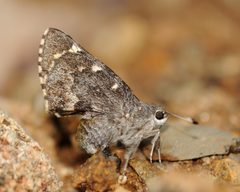
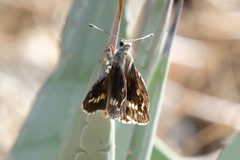
Large, robust with broad wings. typically exhibit dark brown to blackish ground coloration with variable pale or orange markings. Wingspan is relatively large compared to other skippers. terminate in hooked clubs characteristic of the Hesperiidae. Body is thick and毛茸茸, adapted for or activity patterns.
Habitat
Arid and semi-arid desert environments including Sonoran Desert, Chihuahuan Desert, Mojave Desert, and adjacent dry scrublands. Elevation ranges from low desert valleys to montane slopes where agave occur. specificity is tightly linked to presence of larval plants in Agave.
Distribution
Southwestern United States (Arizona, New Mexico, California, Nevada, Utah, Texas) through Mexico to Rica. Core distribution centers in the Madrean sky islands and Mexican Plateau, with peripheral in Baja California and Central America.
Seasonality
fly primarily in late summer and fall (July–November), with peak activity varying by and locality. Timing corresponds with monsoon rainfall patterns and agave flowering periods in desert regions.
Diet
Larvae bore into and feed on stems and roots of agave plants (Agave spp.). feeding habits are poorly documented; adults have been observed at agave nectar and possibly other floral sources.
Host Associations
- Agave - larval Stem-boring larvae feed internally on agave stems and roots
Life Cycle
are laid on agave plants. Larvae bore into agave stems and undergo development within the plant tissue, taking one or more years to mature depending on and climate. occurs within the agave stem or in soil. are relatively short-lived and do not feed extensively.
Behavior
exhibit to activity, departing from typical patterns of most butterflies. Males patrol for females near agave stands. Larval boring creates internal tunnels in agave stems, with expelled through exit holes.
Ecological Role
Larvae act as specialized herbivores on agave plants, potentially influencing agave and meristem growth. Limited information exists on their role in , though larvae likely serve as prey for and other natural enemies.
Human Relevance
Of interest to lepidopterists due to specialized and taxonomic history. Some have restricted ranges and are of conservation concern. No significant agricultural or economic impact; agave is not materially affected by larval boring.
Similar Taxa
- MegathymusClosely related of giant-skippers with similar and agave stem-boring larvae; distinguished by genitalic structure and subtle wing pattern differences
- StallingsiaRelated in disputed Megathymidae; shares habits and agave association but differs in wing shape and larval
More Details
Taxonomic Controversy
The has been variously treated as belonging to Megathyminae within Hesperiidae, or as the separate Megathymidae along with Megathymus and Stallingsia. This reflects ongoing debate about the phylogenetic placement of these highly specialized skippers.
Conservation Status
Several have extremely restricted ranges (e.g., single mountain ranges or counties) and may be vulnerable to loss, agave harvest, and climate change effects on desert .