
Megathyminae
Röber, 1896
giant skippers, yucca giant skippers
Genus Guides
3- Agathymus(giant-skippers)
- Megathymus(giant-skippers)
- Stallingsia
Megathyminae is a of in the Hesperiidae, commonly known as giant skippers. These are among the largest skippers, characterized by robust bodies, relatively small wings for their body size, and a strong association with succulent plants. The group contains approximately 20 distributed primarily in arid regions of North America. Larvae are endophagous, feeding internally within the stems or roots of plants, particularly yuccas and agaves.
Pronunciation
How to pronounce Megathyminae: /ˌmɛgəˈθaɪmɪniː/
These audio files are automatically generated. While they are not always 100% accurate, they are a good starting point.
Identification
Distinguished from other Hesperiidae by the combination of: large, heavy-bodied build; widely separated antennal bases; relatively small wings; and association with yucca or agave . The -like resting posture and slow, deliberate pattern separate them from most other skippers. The Megathymus has more extensive pale wing markings than Agathymus. Unlike spread-wing skippers (Pyrginae), they lack the rapid, darting flight. The large size and endophagous larval are unique among North American skippers.
Images
Appearance
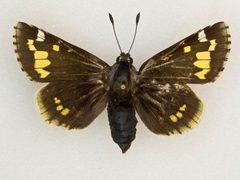
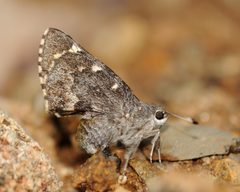
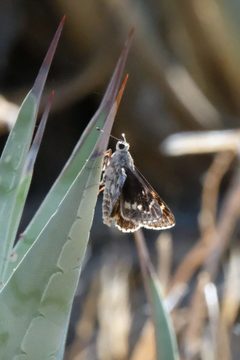
Large-bodied skippers with thick, muscular and relatively small wings compared to body mass. Wings are typically dark brown to black with white, yellow, or orange spots and bands. are widely separated at the base, with hooked clubs. Forewings are more triangular than in other skippers, and hindwings are rounded. have a -like appearance when at rest, with wings held flat or slightly tented. Body length ranges from 25–40 mm, with wingspans of 35–60 mm.
Habitat
Arid and semi-arid regions including deserts, dry grasslands, and scrublands. Strongly associated with containing Yucca and Agave . Elevational range from sea level to approximately 2,000 meters. Prefers open, sunny areas with sandy or rocky soils where plants grow.
Distribution
Primarily southwestern United States and northern Mexico, extending from southern California east to Texas and south into central Mexico. Disjunct occur in Florida (Yucca filamentosa feeders). The is to North America.
Seasonality
fly primarily in spring and summer, with most active from March to September depending on elevation and latitude. Some high-elevation species have shorter periods in mid-summer. is often triggered by monsoon rains or seasonal warming.
Diet
Larvae feed endophagously within the stems, crowns, and roots of Yucca and Agave . Specific associations vary by species; some are restricted to single host species. have reduced mouthparts and do not feed, or feed rarely on moisture sources.
Host Associations
- Yucca - larval primary ; larvae tunnel in stems and roots
- Agave - larval secondary for some
Life Cycle
are laid singly on plants. Larvae tunnel into plant tissue and feed internally, taking one to several years to develop depending on and climate. occurs within the host plant or in soil near the base. are short-lived, surviving days to weeks. Most species appear to have a single per year, though some may take multiple years to complete development.
Behavior
have a slow, bouncing pattern distinct from other skippers. Males patrol territories near plants, occasionally perching on low vegetation. Females oviposit on host plants, often selecting specific locations on stems or leaf bases. Larvae are sedentary once established within host tissue. Adults are primarily but may be in hot climates.
Ecological Role
Larvae act as stem-borers in yucca and agave , potentially affecting plant and . Limited information on or . may serve as minor of plants during oviposition, though this has not been quantified.
Human Relevance
Larvae can be pests in commercial yucca and agave , particularly in fiber and tequila production. are sought by collectors due to their large size and limited distribution. Some are of conservation concern due to loss and plant removal.
Similar Taxa
- Hesperiinae (grass skippers)Similar size range but differ in rapid, erratic , rounded wing shapes, and larval feeding on grasses rather than endophagy in succulents
- Pyrginae (spread-wing skippers)Share some wing pattern elements but have faster , different antennal structure, and larvae that feed externally on varied
- Castniidae (giant skippers)Convergent and large size, but these are tropical (not butterflies) with clubbed but unhooked and different wing venation
More Details
Endophagous biology
The is notable among Lepidoptera for the highly specialized endophagous larval habit. Larvae possess strong adapted for chewing through tough fibrous plant tissue and can survive for extended periods within the water-storing stems and roots of their .
Taxonomic history
Historically treated as a separate (Megathymidae) due to distinctive and , but molecular and morphological studies support placement within Hesperiidae as a .