
Copaeodes
Speyer, 1877
Species Guides
2- Copaeodes aurantiaca(orange skipperling)
- Copaeodes minima(southern skipperling)
Copaeodes is a of skippers ( Hesperiidae, Hesperiinae) established by Speyer in 1877. The genus contains six recognized distributed in the Americas, including the orange skipperling (Copaeodes aurantiaca). Species are typically small, orange-colored skippers. The genus was formerly considered a subgenus of Oarisma by some authorities, though this classification is not universally accepted.
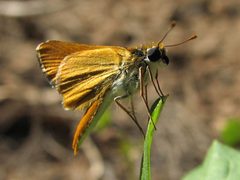
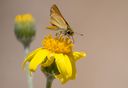
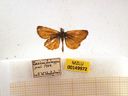
Pronunciation
How to pronounce Copaeodes: //kɔˈpaɪ̯.oʊ.diːz//
These audio files are automatically generated. While they are not always 100% accurate, they are a good starting point.
Identification
in Copaeodes are small skippers with orange or orange-brown coloration. The can be distinguished from similar small orange skippers by genitalic characters and wing pattern details, though species-level identification requires examination of specimens. Copaeodes aurantiaca, the orange skipperling, is characterized by bright orange wings with dark margins.
Images
Habitat
occur in open, sunny including grasslands, prairies, and disturbed areas. Copaeodes aurantiaca has been observed in gardens and urban green spaces with abundant flowering plants.
Distribution
The ranges through North, Central, and South America. Individual distributions vary: Copaeodes aurantiaca occurs from the southwestern United States through Mexico; Copaeodes minima is found in the southern United States; other species occur in Central and South America.
Seasonality
are active during warmer months. In the southwestern United States, Copaeodes aurantiaca has been observed flying in late summer and early autumn (August-September).
Diet
Larval plants are grasses (Poaceae). feed on nectar from flowers.
Life Cycle
Complete with , larva, pupa, and stages. Larvae feed on grasses. Specific details of development duration and stage vary by and are not well documented for most .
Behavior
are rapid, darting fliers typical of skippers. They visit flowers for nectar and males may perch to await females.
Ecological Role
Larvae are primary consumers feeding on grasses. serve as when visiting flowers. The contributes to local biodiversity in grassland .
Human Relevance
Copaeodes aurantiaca is occasionally noted by enthusiasts and has been recorded from gardens. No significant economic or agricultural impacts are documented.
Similar Taxa
- OarismaFormerly considered congeneric or treated as a subgenus; distinguished by genitalic and wing venation characters
- HylephilaSimilar small orange skippers; Hylephila phyleus (fiery skipper) overlaps in range and but has different wing pattern and
- AncyloxyphaSmall orange skippers with similar preferences; distinguished by wing shape and pattern details
More Details
Taxonomic History
NCBI treats Copaeodes as a subgenus of Oarisma, while Catalogue of Life and most lepidopterological sources recognize it as a valid . The former Copaeodes eunus was transferred to Pseudocopaeodes.
Species List
Six recognized : C. aurantiaca (Hewitson, 1868), C. castanea Mielke, 1969, C. eoa Smith, Miller & McKenzie, 1991, C. jean Evans, 1955, C. minima (Edwards, 1870), C. stillmani Bell & Comstock, 1948.