
Hylephila phyleus
(Drury, 1773)
Fiery Skipper
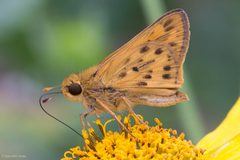
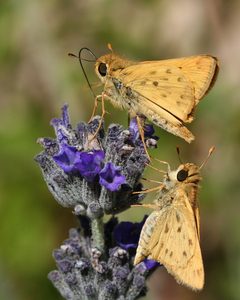
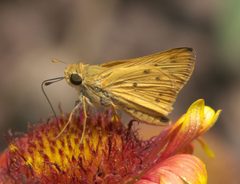
Hylephila phyleus, commonly known as the Fiery Skipper, is a small in the Hesperiidae. are approximately 2.5 cm long, with males displaying orange or yellow coloration with black spots and females appearing dark brown with orange or yellow spots. The has been documented across a broad geographic range including North America, the Caribbean, Middle America, and Oceania. It is known to be active in late winter through fall, with records from January through November in California. The caterpillars feed on various grasses and are sometimes considered pests of turf grasses.
Pronunciation
How to pronounce Hylephila phyleus: /haɪˈlɛfɪlə ˈfaɪliəs/
These audio files are automatically generated. While they are not always 100% accurate, they are a good starting point.
Identification
Males can be distinguished by their bright orange or yellow ground color with contrasting black spots. Females are darker, with brown base color and orange or yellow spots. The can be separated from similar skippers by the combination of small size, spotted pattern, and in coloration. The angular hindwing margin and rapid, darting typical of skippers in the Hesperiidae are also characteristic.
Images
Appearance
are small, approximately 1 inch (2.5 cm) in length. Males are orange or yellow with black spots. Females are dark brown with orange or yellow spots. Caterpillars are greenish-pink with a black .
Habitat
Occurs in diverse open including grasslands, meadows, urban and suburban areas, and gardens. The has been observed in shortleaf pine/scarlet oak upland forests in Missouri and in dry vegetation in California. Associated with areas where larval grasses are present.
Distribution
Widespread across the Americas and Pacific. Documented from North America (including the United States from Pennsylvania west to California, and south through the Southwest), the Caribbean, Middle America, and Oceania (including Hawaii). Records include San Andrés y Providencia in the Caribbean. The is expanding its range in some areas and has been recorded as far north as Missouri.
Seasonality
are active from late winter through fall. In central California, first has been recorded as early as January 26 (an exceptional record), with more typical first appearances in February or March. In the Sacramento Valley, adults have been observed from January through November. Multiple occur throughout the season.
Diet
Caterpillars feed on grasses including Bermudagrass (Cynodon dactylon), creeping bentgrass (Agrostis stolonifera), and St. Augustine grass (Stenotaphrum secundatum). butterflies nectar at flowers.
Host Associations
- Cynodon dactylon - larval Bermudagrass
- Agrostis stolonifera - larval creeping bentgrass
- Stenotaphrum secundatum - larval St. Augustine grass
Life Cycle
Complete with , larva (caterpillar), pupa, and stages. Caterpillars are greenish-pink with black . occurs in a silken cocoon. Multiple per year with adults in some regions. In California, the last fall- sightings typically occur in November, with overwintering adults or pupae resuming activity in late winter or early spring.
Behavior
exhibit rapid, darting characteristic of skippers. Males are known to perch and defend territories. Adults frequently visit flowers for nectar. In California, males have been observed engaging in basking to raise body temperature for flight.
Ecological Role
serve as when nectaring at flowers. Caterpillars function as herbivores on grasses. The serves as a food source for various including birds and other insects. Documented increases in some regions suggest adaptability to anthropogenic .
Human Relevance
Caterpillars are sometimes considered pests of turf grasses and lawns, particularly Bermudagrass, creeping bentgrass, and St. Augustine grass. The is popular among watchers and photographers due to its bright coloration and approachable at flowers. Used as a study organism for research on butterfly seasonality and climate change effects, particularly in long-term monitoring programs in California.
Similar Taxa
- HylephilaOther in the share similar size and general skipper , but H. phyleus is distinguished by its specific color pattern and geographic range.
- Atalopedes campestrisField Skipper shares similar and but differs in coloration and wing pattern.
- Ochlodes sylvanoidesWoodland Skipper occurs in similar regions but prefers different and has distinct markings.
More Details
Climate and phenology research
The has been extensively studied in central California by Art Shapiro, who has monitored since 1972. Records show the Fiery Skipper is emerging earlier in response to regional climate warming, with the earliest recorded first appearance in the Sacramento Valley on January 26, 2015. The species is considered to be doing well compared to declining butterfly populations in the same region.
Population status
Listed among perceived to be doing well in central California, in contrast to declining species such as the monarch, West Coast lady, and large marble. levels have remained stable or increased in long-term monitoring data from the Sacramento Valley and Sierra Nevada foothills.