
Atalopedes campestris
(Boisduval, 1852)
Field Skipper, sachem
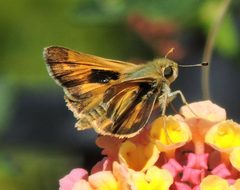
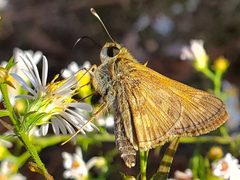
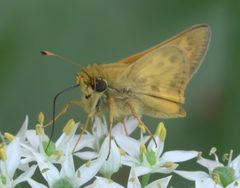
Atalopedes campestris, commonly known as the field skipper or sachem, is a small grass in the Hesperiidae. have a wingspan of 35–41 mm. Males are orange with brown edges and a large black stigma on the forewing; females are darker brown with variable lighter markings. The has undergone significant northward range expansion in North America during the 21st century, attributed to winter warming trends associated with climate change. In 2022, the eastern North American was designated as a separate species, A. huron (huron sachem).
Pronunciation
How to pronounce Atalopedes campestris: /ˌætəloʊˈpiːdiːz kæmˈpestrɪs/
These audio files are automatically generated. While they are not always 100% accurate, they are a good starting point.
Identification
Distinguished from similar Hesperia skippers by: male's large four-sided black stigma on orange forewing; female's square white transparent spot at end of forewing . Female dark brown upperside with golden spots contrasts with male orange coloration. Underside pattern of female hindwing with four-sided light spots also aids identification. Eastern now classified as A. huron following 2022 taxonomic revision.
Images
Habitat
Open, disturbed areas including roadsides, lawns, pastures, parks, oil fields, and landfills. Shortgrass prairie and mesquite chaparral. Associated with grassy areas where larval plants occur.
Distribution
Southern United States ranging south through Mexico and Central America to Colombia, Venezuela, Ecuador, and Brazil. Northern range extends during warmer months to Montana, Washington, and New York, excluding most of Rocky Mountains. Irregular records from Manitoba, Canada (photographed 2015) and strays reported in British Columbia (1937, 1953, 1960). Eastern North American now recognized as separate A. huron.
Seasonality
Three periods (May through November) in northern part of range. Four to five flights (March through December) in southern part of range. active during warmer months with northward in late summer.
Diet
feed on nectar from flowers including Helianthus annuus ( sunflower).
Host Associations
- Bermuda grass - larval plant
- hairy crabgrass - larval plant
- red fescue - larval plant
- St. Augustine grass - larval plant
- Indian goosegrass - larval plant
- seashore saltgrass - larval plant
- Imperata cylindrica - larval plant
Life Cycle
Complete with four stages. greenish-white, laid singly on or near plant leaves, 0.9–1.0 mm high, 0.6–0.7 mm wide, with polygonal sculpturing. Larva passes through five instars, black, body dark olive green with black dots or bumps and dark line, legs brown, 18–40 mm at last instar. Larvae construct leaf-and-silk nests, building new shelters as they grow. Pupa formed in silked-leaf nest, dark brown to almost black with cream-colored abdominal tip bearing brown dots, extends 2 mm beyond wings, 18.0–22.5 mm long.
Behavior
Males perch on grasses during day to await females. engage in northward , with one mass migration event known in late summer. Rapid northward range expansion documented during early 21st century.
Ecological Role
of flowering plants. Larvae are herbivores on various grasses. Serves as prey for and other natural enemies.
Human Relevance
Subject of long-term phenological research by Art Shapiro in California, where it has been one of the most responsive to climate warming, advancing first dates significantly. Used as for studying biotic responses to climate change.
Similar Taxa
- Hesperia speciesOften mistaken for other skippers in this due to general grass skipper and .
- Atalopedes huronEastern North American formerly included in A. campestris, separated in 2022 based on genetic and morphological differences.
Sources and further reading
- BugGuide
- Wikipedia
- GBIF taxonomy match
- iNaturalist taxon
- NCBI Taxonomy
- Catalogue of Life
- Art Shapiro: 'Using Butterflies to Understand Biotic Responses to Climate Change' | Bug Squad
- A Close Call | Bug Squad
- Psychidae | Beetles In The Bush
- Bug Eric: How to (Almost) Catch a Leaf-tier Caterpillar (Video)
- Friday flower – Sabatia angularis | Beetles In The Bush
- ID Challenge #1 | Beetles In The Bush