
Oarisma
Scudder, 1872
skipperling
Species Guides
3- Oarisma edwardsii(Edwards's Skipperling)
- Oarisma garita(Garita Skipperling)
- Oarisma poweshiek(Poweshiek Skipperling)
Oarisma is a of grass skippers ( Hesperiidae) comprising approximately 14 described distributed throughout the Americas. Species range from the United States through Central America and the Caribbean to South America. The genus includes the federally endangered Poweshiek skipperling (O. poweshiek), which has undergone dramatic declines and is now restricted to six extant sites in the upper Midwest United States and Manitoba, Canada. In 2019, species formerly placed in the genus Copaeodes were transferred to Oarisma based on taxonomic revision.
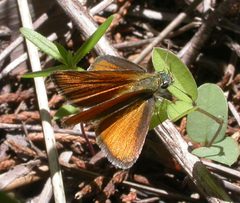
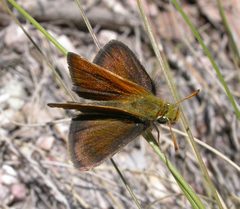
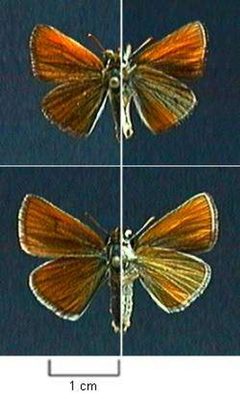
Pronunciation
How to pronounce Oarisma: /oʊˈærɪzmə/
These audio files are automatically generated. While they are not always 100% accurate, they are a good starting point.
Identification
Small-bodied butterflies with wingspans typically 2.3–3.0 cm. within Oarisma are distinguished from similar grass skippers by genitalic and wing pattern characters; precise identification often requires examination of male genitalia. O. poweshiek can be distinguished from the western O. garita by subtle differences in wing pattern and genitalic —12 occurrence records in aggregated datasets were misidentified as O. poweshiek when they were actually O. garita.
Images
Habitat
Prairie and grassland . O. poweshiek specifically occupies prairie fens in Michigan, mesic prairie in Wisconsin, and tallgrass prairie in Manitoba. fly almost exclusively within prairie plant and are rarely observed in shrub, wetland, or forest communities. -laying microhabitats are characterized as more open with drier microclimates compared to surrounding areas.
Distribution
distributed throughout the Americas: United States (south to Texas and Florida), Mexico, Central America, Caribbean (Cuba, Hispaniola, Virgin Islands), and South America. O. poweshiek historically occurred in ten U.S. states (Illinois, Indiana, Iowa, Michigan, Minnesota, Nebraska, North Dakota, Ohio, South Dakota, Wisconsin) and southeast Manitoba, Canada; currently extant at only six sites.
Seasonality
O. poweshiek is with period mid-June to mid-July. Other ' flight periods vary by latitude and elevation.
Diet
Larvae of O. poweshiek feed on graminoid : Andropogon gerardi, Muhlenbergia richardsonis, Sporobolus heterolepis, and Schizachyrium scoparium (all Poaceae). Larvae alternate between shoots of various species throughout development. O. poweshiek nectar primarily on Rudbeckia hirta (black-eyed Susan).
Host Associations
- Andropogon gerardi - larval food plantbig bluestem
- Muhlenbergia richardsonis - larval food plantmat muhly
- Sporobolus heterolepis - larval food plantprairie dropseed
- Schizachyrium scoparium - larval food plantlittle bluestem
- Rudbeckia hirta - nectar sourceblack-eyed Susan; primary nectar plant for O. poweshiek in Manitoba
Life Cycle
(one per year). Development includes , larval (with 5–7 instars observed in O. garita), pupal, and stages. O. poweshiek larvae overwinter, with accumulation from egg hatch to studied using thermal thresholds of 6°C and 32°C. may act to synchronize adult . Ex-situ rearing of O. garita demonstrated that larvae can complete development in 5, 6, or 7 instars without maintaining consistent size ratios between instars, casting doubt on the applicability of for instar determination in this .
Behavior
Larvae navigate microhabitats to locate food plants. O. poweshiek activities are distributed along a soil moisture gradient: -laying associated with mesic conditions, resting/basking with drier conditions, and nectar feeding across the gradient. Breeding in ex-situ settings are positively associated with sunlight intensity and negatively associated with age for both sexes; ambient temperature showed no significant effect on breeding frequency.
Ecological Role
in prairie . O. poweshiek abundance in Manitoba is positively associated with of Rudbeckia hirta, indicating potential mutualistic relationships with this nectar plant.
Human Relevance
O. poweshiek listed as Federally Endangered in the United States and Canada in 2014. Subject to intensive conservation efforts including ex-situ captive breeding, management, and reintroduction programs. use limitation areas (PULAs) established in Midwest states to protect remaining . Research on this has informed broader understanding of climate change vulnerability in prairie butterflies and contributed to development of species distribution modeling methodologies with field validation.
Similar Taxa
- CopaeodesFormerly treated as separate ; transferred to Oarisma in 2019 based on taxonomic revision. Some sources still list these species under Copaeodes.
- Oarisma garitaWestern similar in appearance to O. poweshiek; distinguished by wing pattern and genitalic characters. Historical misidentifications between these have occurred in occurrence datasets.
More Details
Taxonomic History
In 2019, the Taxonomic Report of the International Lepidoptera Survey published information placing of the Copaeodes into Oarisma. These species are still sometimes treated as members of the former genus Copaeodes in older literature and databases.
Conservation Genetics
genetic studies of O. poweshiek using nine microsatellite loci revealed historically high among populations from southern Manitoba to Michigan, with weak genetic differentiation and no isolation by distance. This suggests that recent rapid population declines cannot be explained solely by fragmentation given the ' limited ability.
Climate Sensitivity
Comparative studies of O. poweshiek and O. garita ontogeny demonstrated that O. poweshiek exhibits lower variability in developmental rates, suggesting reduced to climate change compared to its . Elevated temperatures can accelerate larval development causing in the same season without , potentially disrupting phenological synchronization.
Habitat Management
O. poweshiek abundance in Manitoba is positively associated with recent burning and grazing management that maintains early successional prairie stages, and negatively associated with years since last burn or grazing event. Cumulative May-June precipitation negatively affects abundance, while warm early springs and cool temperatures during the active period have positive effects.
Sources and further reading
- BugGuide
- Wikipedia
- GBIF taxonomy match
- iNaturalist taxon
- NCBI Taxonomy
- Catalogue of Life
- A Brief Guide to Pesticide Mitigations, Label Changes to Protect Endangered Species
- rusty patched bumble bee and Poweshiek skipperling - Entomology Today
- pesticide use limitation areas - Entomology Today
- Observations on life history of Oarisma powesheik (Parker) 1870
- Endangered Oarisma poweshiek larvae vary their graminoid forage in Manitoba, Canada
- Aggregated occurrence records of the federally endangered Poweshiek skipperling (Oarisma poweshiek)
- Endangered Oarisma poweshiek butterfly larval foraging and adult habitat interactions in Manitoba, Canada
- Life history and ecology of the endangered Poweshiek skipperling Oarisma poweshiek in Michigan prairie fens
- Management practices benefit endangered Poweshiek skipperling (Oarisma poweshiek) in Manitoba tall grass prairie
- Adult activities of endangered Oarisma poweshiek butterflies are associated with a soil moisture gradient in tall grass prairie in Manitoba, Canada
- The role of ambient temperature in the ontogeny of endangered Oarisma poweshiek and their relative O. garita reared ex-situ at Assiniboine Park Zoo, Manitoba
- Conservation genetics of an endangered grassland butterfly ( Oarisma poweshiek ) reveals historically high gene flow despite recent and rapid range loss
- A field‐validated species distribution model to support management of the critically endangered Poweshiek skipperling ( Oarisma poweshiek ) butterfly in Canada
- Breeding Behaviors of the Endangered Prairie Butterfly Oarisma poweshiek (Lepidoptera: Hesperiidae) in Relation to Environmental Factors in an Ex Situ Conservation Setting