
Oarisma garita
(Reakirt, 1866)
Garita Skipperling, Western Skipperling, Garita Skipper
A small grass skipper native to North American prairies and open . are active in early summer with a period from mid-June through mid-July. The has been studied as a comparative model for understanding temperature effects on development in the endangered O. poweshiek.

Pronunciation
How to pronounce Oarisma garita: /oʊˈɛərɪsmə ɡəˈraɪtə/
These audio files are automatically generated. While they are not always 100% accurate, they are a good starting point.
Identification
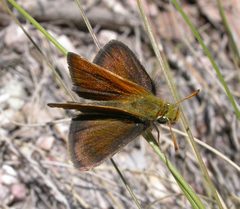
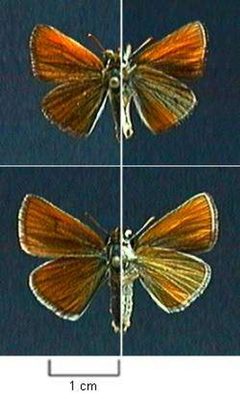
Distinguished from similar small skippers by the combination of orange-brown upperside and the distinctive hindwing underside pattern: dark gray with orange inner margins and gray-white . The small wingspan (20–25 mm) and early summer period help separate it from later-flying .
Images
Appearance
Wingspan 20–25 mm. Upperside orange-brown. Forewing underside orange; hindwing underside dark gray with orange inner margins and gray-white .
Habitat
Dry or moist prairies, open woodlands, and limestone outcrops.
Distribution
Southeastern Manitoba to British Columbia, south through the American Midwest to Mexico.
Seasonality
fly from mid-June through mid-July.
Diet
Larvae feed on grasses including Sitanion, Blepharoneuron, Stipa, Poa, and Bouteloua. feed on flower nectar.
Life Cycle
Complete with , larva, pupa, and stages. Larvae overwinter. Development is temperature-dependent; ex-situ studies indicate larvae may complete development in five, six, or seven instars. appears to act as a developmental 'reset' mechanism promoting synchronized adult .
Behavior
Ex-situ studies suggest greater developmental plasticity in response to temperature compared to the endangered O. poweshiek. Larvae reared at constant elevated temperatures (28°C) showed accelerated with most eclosing in the same season as hatching, bypassing .
Ecological Role
Grass-feeding herbivore; nectar feeding may contribute to pollination.
Human Relevance
Used as a research surrogate for the endangered Poweshiek skipperling (O. poweshiek) in conservation studies. Not itself listed as endangered.
Similar Taxa
- Oarisma poweshiekEndangered with similar and requirements; O. garita has greater developmental variability and longer period, suggesting greater climate .
Sources and further reading
- BugGuide
- Wikipedia
- GBIF taxonomy match
- iNaturalist taxon
- NCBI Taxonomy
- Catalogue of Life
- A Brief Guide to Pesticide Mitigations, Label Changes to Protect Endangered Species
- rusty patched bumble bee and Poweshiek skipperling - Entomology Today
- pesticide use limitation areas - Entomology Today
- The role of ambient temperature in the ontogeny of endangered Oarisma poweshiek and their relative O. garita reared ex-situ at Assiniboine Park Zoo, Manitoba